Defined public benefit can retain charitable character; registration renewal requires examining genuine activities and legal compliance, not surplus a...
Capital reduction is distinct from share buy-back, preventing buy-back tax; restructuring interest and related business deductions also survive scruti...
Transfer pricing and tax deductions upheld on established principles, while employee contributions and warranty provisions returned for fresh examinat...
Captive transfer pricing relies on industrial consumer tariffs, while genuine quotations can benchmark effluent treatment transfers under the Other Me...
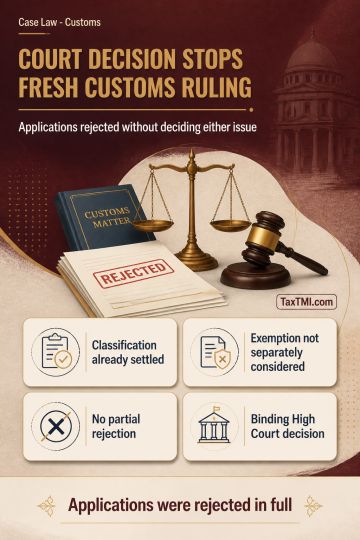
Specific tariff classification for ophthalmic instruments and extended limitation principles determine the treatment of duty demands, confiscation, an...
Integrated golf function determines classification, placing launch monitors and simulators under other golf equipment rather than measuring instrument...
GSTAT has classified GST appeals into three categories and mapped them to Single, Division and designated benches. Matters below the specified threshold and not involving a question of law are to be placed before a Single Bench, while pending and future matters before the Principal and State Benches are to be listed first before a Division Bench, which may remit cases lacking a question of law for further directions. Category I covers core classification, valuation, input tax credit, registration and tax-liability disputes; Category II covers registration, composition, recovery, refund, assessment and related matters; Category III covers seizure, confiscation, rectification, penalty, compounding and residual matters. The order also assigns member combinations, hearing days and travel/daily expense entitlements for members posted away from their normal station.
GSTAT has classified GST appeals into three categories and mapped them to Single, Division and designated benches. Matters below the specified threshold and not involving a question of law are to be placed before a Single Bench, while pending and future matters before the Principal and State Benches are to be listed first before a Division Bench, which may remit cases lacking a question of law for further directions. Category I covers core classification, valuation, input tax credit, registration and tax-liability disputes; Category II covers registration, composition, recovery, refund, assessment and related matters; Category III covers seizure, confiscation, rectification, penalty, compounding and residual matters. The order also assigns member combinations, hearing days and travel/daily expense entitlements for members posted away from their normal station.
Note: It is a system-generated summary and is for quick reference only.
 TaxTMI
  TaxTMI
 of 4809

















 Join Channel