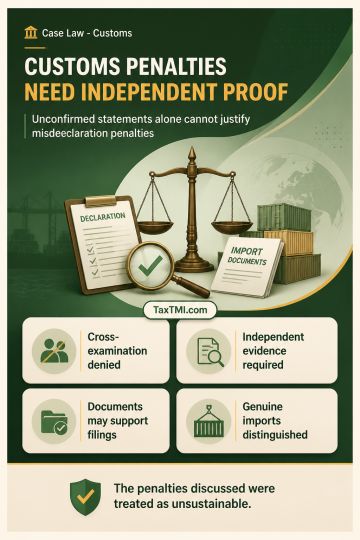
Cross-examination rights and corroborated evidence limit customs penalties for misdeclaration in genuine import transactions involving documented clea...
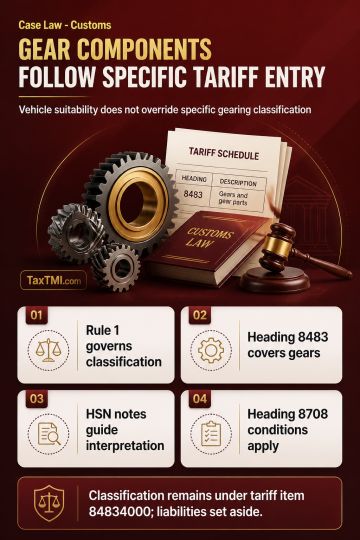
Tariff classification of vehicle gear components follows the specific gearing entry, displacing motor-vehicle parts classification and related liabili...
Necessary-party requirements limit impleadment of independent entities, while deferred consideration does not create an appealable adverse determinati...
Food supplement classification requires common parlance and authoritative tests, preventing treatment as proprietary Ayurvedic medicines without suppo...
Specified regulatory authority income receives conditional tax exemption, subject to non-commercial activity, unchanged income character, and return f...
Tax exemption for regulatory authority income applies retrospectively, subject to non-commercial activity, unchanged income sources, and return-filing...
GSTAT has classified GST appeals into three categories and mapped them to Single, Division and designated benches. Matters below the specified threshold and not involving a question of law are to be placed before a Single Bench, while pending and future matters before the Principal and State Benches are to be listed first before a Division Bench, which may remit cases lacking a question of law for further directions. Category I covers core classification, valuation, input tax credit, registration and tax-liability disputes; Category II covers registration, composition, recovery, refund, assessment and related matters; Category III covers seizure, confiscation, rectification, penalty, compounding and residual matters. The order also assigns member combinations, hearing days and travel/daily expense entitlements for members posted away from their normal station.
GSTAT has classified GST appeals into three categories and mapped them to Single, Division and designated benches. Matters below the specified threshold and not involving a question of law are to be placed before a Single Bench, while pending and future matters before the Principal and State Benches are to be listed first before a Division Bench, which may remit cases lacking a question of law for further directions. Category I covers core classification, valuation, input tax credit, registration and tax-liability disputes; Category II covers registration, composition, recovery, refund, assessment and related matters; Category III covers seizure, confiscation, rectification, penalty, compounding and residual matters. The order also assigns member combinations, hearing days and travel/daily expense entitlements for members posted away from their normal station.
Note: It is a system-generated summary and is for quick reference only.
 TaxTMI
  TaxTMI
 of 4813


















 Join Channel