Development agreements require legal possession or effective enjoyment for capital gains transfer; permissive possession and deferred consideration de...
Prolonged sterilisation of development rights supports capital-gains treatment, while business-income disallowances cannot govern capital-gains comput...
Additional evidence in transfer pricing dispute leads to fresh examination, while tax deductions, TDS credit, fee and refund interest require verifica...
Category II AIF pass-through taxation preserves non-business income character; investment receipts cannot be reclassified without applying recognised ...
Mutual fund maturity rules require proper rollover, redemption, disclosure, and due diligence; investor gains cannot excuse regulatory breaches or pen...
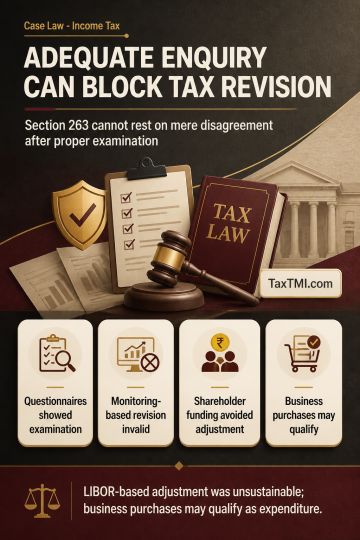
Ad hoc disallowance of business expenditure was deleted because the assessee had produced books of account, bills, vouchers, stock register, purchase details, bank statements and expense vouchers, and the books were not rejected under section 145(3). In respect of purchases from one supplier, the estimated profit addition was deleted in full because payments were through banking channels, supporting records were filed, notices were replied to by the supplier confirming the transactions, and there was no evidence of cash return or doubt about corresponding sales. For another supplier, only the embedded profit in the disputed purchases was brought to tax as grey market purchases, and the addition was restricted to 2 per cent.
Ad hoc disallowance of business expenditure was deleted because the assessee had produced books of account, bills, vouchers, stock register, purchase details, bank statements and expense vouchers, and the books were not rejected under section 145(3). In respect of purchases from one supplier, the estimated profit addition was deleted in full because payments were through banking channels, supporting records were filed, notices were replied to by the supplier confirming the transactions, and there was no evidence of cash return or doubt about corresponding sales. For another supplier, only the embedded profit in the disputed purchases was brought to tax as grey market purchases, and the addition was restricted to 2 per cent.
Note: It is a system-generated summary and is for quick reference only.
 TaxTMI
 of 4807

















 Join Channel


 TaxTMI