Opportunity to respond to jurisdictional reports is mandatory before customs settlement duty enhancement; connected applications require consistent ad...
Specific customs headings for scaffolding components prevail over general classification, invalidating misclassification proceedings and enabling with...
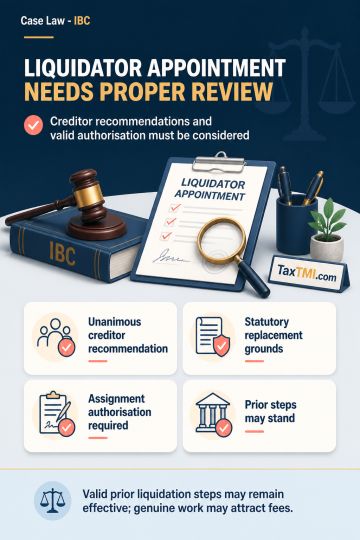
Liquidator appointment under Section 34 requires consideration of creditor recommendations, valid professional authorisation, and preservation of vali...
Income-tax exemption for specified regulatory fees and government grants applies subject to non-commercial activity and continuing compliance conditio...
Page of 4811
Press 'Enter' after typing page number.
781 to 800 of 96208 Results
❮
❯
❯❯
0 / 200
Expand Note
Add to Folder
No Folders have been created
+
Are you sure you want to delete "My most important" ?
Ad hoc disallowance of business expenditure was deleted because the assessee had produced books of account, bills, vouchers, stock register, purchase details, bank statements and expense vouchers, and the books were not rejected under section 145(3). In respect of purchases from one supplier, the estimated profit addition was deleted in full because payments were through banking channels, supporting records were filed, notices were replied to by the supplier confirming the transactions, and there was no evidence of cash return or doubt about corresponding sales. For another supplier, only the embedded profit in the disputed purchases was brought to tax as grey market purchases, and the addition was restricted to 2 per cent.
Ad hoc disallowance of business expenditure was deleted because the assessee had produced books of account, bills, vouchers, stock register, purchase details, bank statements and expense vouchers, and the books were not rejected under section 145(3). In respect of purchases from one supplier, the estimated profit addition was deleted in full because payments were through banking channels, supporting records were filed, notices were replied to by the supplier confirming the transactions, and there was no evidence of cash return or doubt about corresponding sales. For another supplier, only the embedded profit in the disputed purchases was brought to tax as grey market purchases, and the addition was restricted to 2 per cent.
Note: It is a system-generated summary and is for quick reference only.
 TaxTMI
  TaxTMI
 of 4811












 Join Channel


