Capital reduction is distinct from share buy-back, preventing buy-back tax; restructuring interest and related business deductions also survive scruti...
Transfer pricing and tax deductions upheld on established principles, while employee contributions and warranty provisions returned for fresh examinat...
Captive transfer pricing relies on industrial consumer tariffs, while genuine quotations can benchmark effluent treatment transfers under the Other Me...
Specific tariff classification for ophthalmic instruments and extended limitation principles determine the treatment of duty demands, confiscation, an...
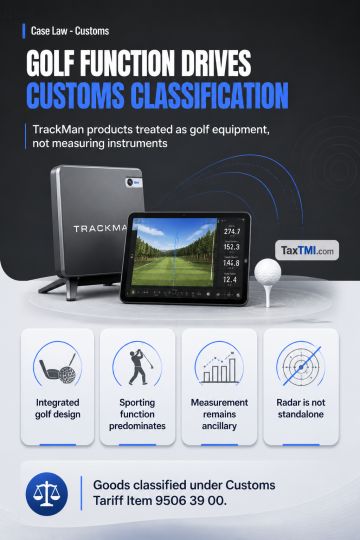
Integrated golf function determines classification, placing launch monitors and simulators under other golf equipment rather than measuring instrument...
Public servant status under anti-corruption law extends to recognised stock exchange leadership; constitutional and sanction challenges do not succeed...
Page of 4809
Press 'Enter' after typing page number.
1341 to 1360 of 96174 Results
❮
❯
❯❯
0 / 200
Expand Note
Add to Folder
No Folders have been created
+
Are you sure you want to delete "My most important" ?
Physical and mechanical beneficiation that removes foreign matter and concentrates mineral content was treated as manufacture under Chapter Note 4 to Chapter 26, and the goods were classifiable as concentrates. Despite failure to follow CT-3 and related procedure, duty-free clearances to 100% EOUs could not be denied because the lapse arose from a bona fide belief that the goods were not dutiable, and the law did not require an impossible act. The department also failed to prove that the disputed clearances were not as such supplies, so those sales were excluded from turnover. The extended limitation period was rejected because suppression, clandestine removal, and intent to evade duty were not established in an interpretational dispute, and the demand, interest and penalty were set aside.
Physical and mechanical beneficiation that removes foreign matter and concentrates mineral content was treated as manufacture under Chapter Note 4 to Chapter 26, and the goods were classifiable as concentrates. Despite failure to follow CT-3 and related procedure, duty-free clearances to 100% EOUs could not be denied because the lapse arose from a bona fide belief that the goods were not dutiable, and the law did not require an impossible act. The department also failed to prove that the disputed clearances were not as such supplies, so those sales were excluded from turnover. The extended limitation period was rejected because suppression, clandestine removal, and intent to evade duty were not established in an interpretational dispute, and the demand, interest and penalty were set aside.
Note: It is a system-generated summary and is for quick reference only.
 TaxTMI
  TaxTMI
 of 4809



















 Join Channel