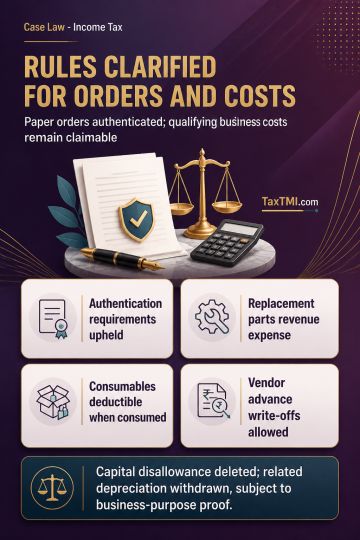
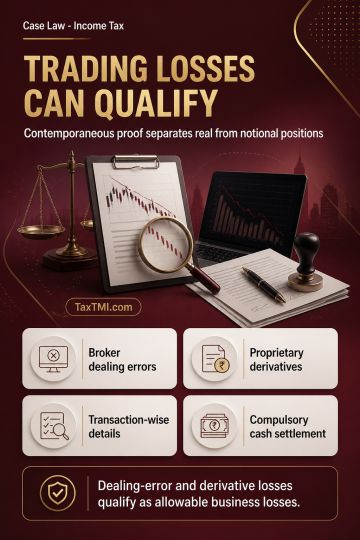
Authentication of paper assessment orders upheld, while qualifying repairs, consumables and vendor advance write-offs remain deductible business claim...
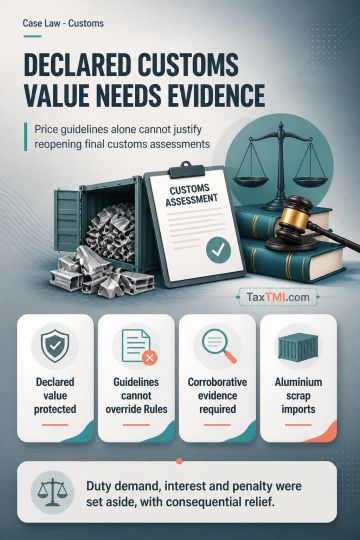
Transaction value cannot be rejected solely on non-statutory valuation guidelines without corroborative evidence supporting reassessment of final cust...
Cross-examination rights and corroborated evidence limit customs penalties for misdeclaration in genuine import transactions involving documented clea...
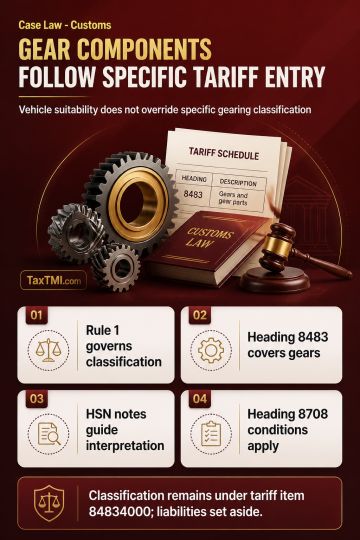
Tariff classification of vehicle gear components follows the specific gearing entry, displacing motor-vehicle parts classification and related liabili...
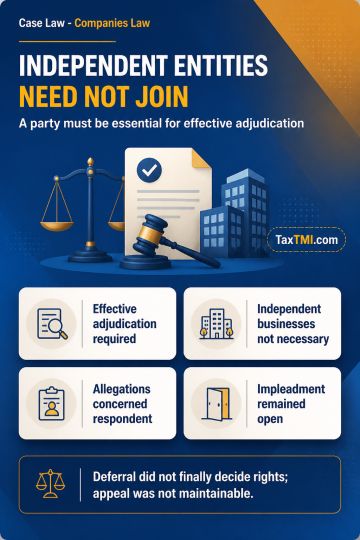
Necessary-party requirements limit impleadment of independent entities, while deferred consideration does not create an appealable adverse determinati...
Physical and mechanical beneficiation that removes foreign matter and concentrates mineral content was treated as manufacture under Chapter Note 4 to Chapter 26, and the goods were classifiable as concentrates. Despite failure to follow CT-3 and related procedure, duty-free clearances to 100% EOUs could not be denied because the lapse arose from a bona fide belief that the goods were not dutiable, and the law did not require an impossible act. The department also failed to prove that the disputed clearances were not as such supplies, so those sales were excluded from turnover. The extended limitation period was rejected because suppression, clandestine removal, and intent to evade duty were not established in an interpretational dispute, and the demand, interest and penalty were set aside.
Physical and mechanical beneficiation that removes foreign matter and concentrates mineral content was treated as manufacture under Chapter Note 4 to Chapter 26, and the goods were classifiable as concentrates. Despite failure to follow CT-3 and related procedure, duty-free clearances to 100% EOUs could not be denied because the lapse arose from a bona fide belief that the goods were not dutiable, and the law did not require an impossible act. The department also failed to prove that the disputed clearances were not as such supplies, so those sales were excluded from turnover. The extended limitation period was rejected because suppression, clandestine removal, and intent to evade duty were not established in an interpretational dispute, and the demand, interest and penalty were set aside.
Note: It is a system-generated summary and is for quick reference only.
 TaxTMI
  TaxTMI
 of 4811










 Join Channel