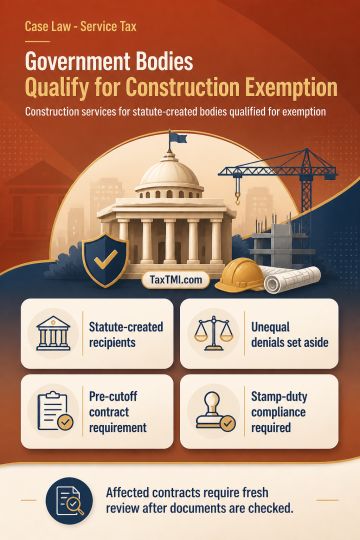
Governmental authority status supports construction-service exemption, while pre-cutoff contract and stamp-duty compliance requires verification on re...
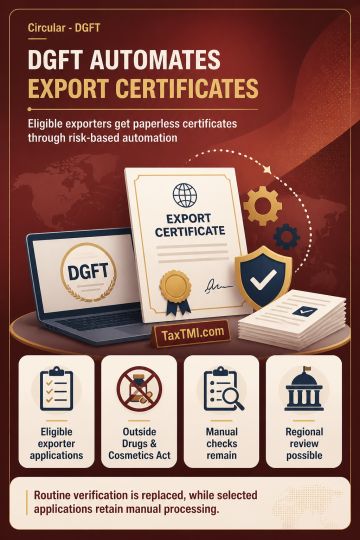
Automated Free Sale and Commerce Certificates enable paperless processing while retaining risk-based manual verification for selected exporter applica...
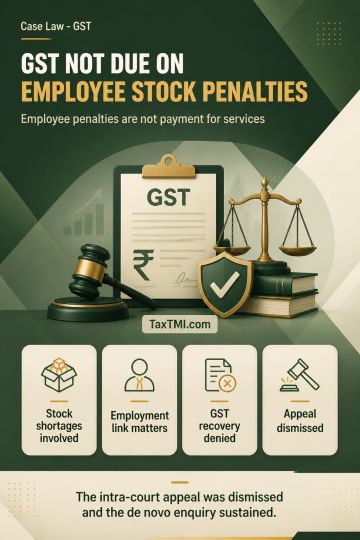
Employee stock-shortage penalties do not constitute consideration for services, preventing GST collection under Schedule II in employment relationship...
A bill of lading clause stating that disputes can be settled by arbitration was held not to create a binding arbitration agreement. At the stage of appointing an arbitrator, the Court confined itself to the prima facie existence of an arbitration agreement and read the clause in its contractual context. The word "can" was treated as permissive, indicating only a possible mode of settlement rather than a mandatory obligation to arbitrate. Applying the principles in K.K. Modi and Jagdish Chander, the Court found that the clause required further consent when a dispute arose and therefore lacked the definitiveness needed to compel arbitration. The refusal to appoint an arbitrator was upheld.
A bill of lading clause stating that disputes can be settled by arbitration was held not to create a binding arbitration agreement. At the stage of appointing an arbitrator, the Court confined itself to the prima facie existence of an arbitration agreement and read the clause in its contractual context. The word "can" was treated as permissive, indicating only a possible mode of settlement rather than a mandatory obligation to arbitrate. Applying the principles in K.K. Modi and Jagdish Chander, the Court found that the clause required further consent when a dispute arose and therefore lacked the definitiveness needed to compel arbitration. The refusal to appoint an arbitrator was upheld.
Note: It is a system-generated summary and is for quick reference only.
 TaxTMI
  TaxTMI
 of 4828






 Join Channel


