Exempt-income expenditure disallowance is confined to investments that actually generated exempt income, while supported business expenses remain dedu...
Objective characteristics and principal use govern mining-tyre classification, while fresh advance ruling applications may rely on additional technica...
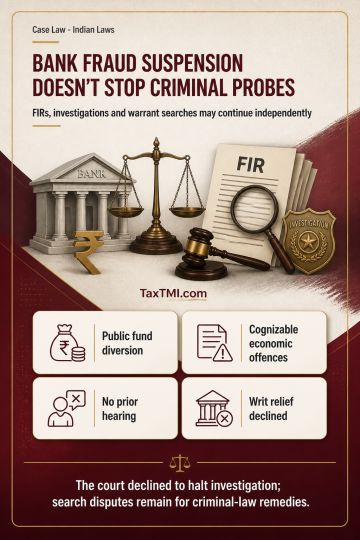
Administrative fraud classification suspension does not halt independent criminal investigation or warrant-based searches into alleged economic offenc...
A bill of lading clause stating that disputes can be settled by arbitration was held not to create a binding arbitration agreement. At the stage of appointing an arbitrator, the Court confined itself to the prima facie existence of an arbitration agreement and read the clause in its contractual context. The word "can" was treated as permissive, indicating only a possible mode of settlement rather than a mandatory obligation to arbitrate. Applying the principles in K.K. Modi and Jagdish Chander, the Court found that the clause required further consent when a dispute arose and therefore lacked the definitiveness needed to compel arbitration. The refusal to appoint an arbitrator was upheld.
A bill of lading clause stating that disputes can be settled by arbitration was held not to create a binding arbitration agreement. At the stage of appointing an arbitrator, the Court confined itself to the prima facie existence of an arbitration agreement and read the clause in its contractual context. The word "can" was treated as permissive, indicating only a possible mode of settlement rather than a mandatory obligation to arbitrate. Applying the principles in K.K. Modi and Jagdish Chander, the Court found that the clause required further consent when a dispute arose and therefore lacked the definitiveness needed to compel arbitration. The refusal to appoint an arbitrator was upheld.
Note: It is a system-generated summary and is for quick reference only.
 TaxTMI
  TaxTMI
 of 4824



















 Join Channel


