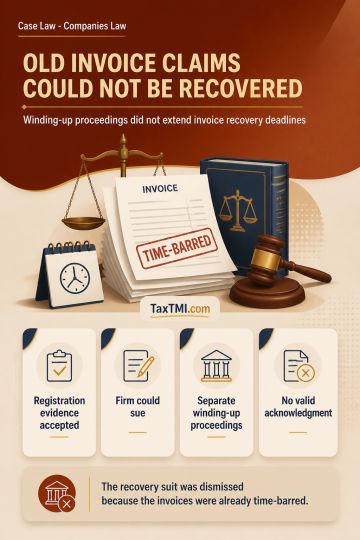
Invoice-based recovery claims remain time-barred despite separate winding-up proceedings, absent valid acknowledgment or part-payment of the disputed ...
Extended limitation fails without specific suppression allegations, while overseas employee secondment remains taxable as manpower supply within norma...
Time-share accommodation classification excludes Club or Association Service where purchasers receive contractual occupancy rights without genuine mem...
CENVAT credit for trading requires reversal, while taxable-service rental credit remains proportionately available and limitation issues await resolut...
Vicarious liability for dishonoured company cheques may extend to non-signatory directors where complaints contain foundational responsibility avermen...
A bill of lading clause stating that disputes can be settled by arbitration was held not to create a binding arbitration agreement. At the stage of appointing an arbitrator, the Court confined itself to the prima facie existence of an arbitration agreement and read the clause in its contractual context. The word "can" was treated as permissive, indicating only a possible mode of settlement rather than a mandatory obligation to arbitrate. Applying the principles in K.K. Modi and Jagdish Chander, the Court found that the clause required further consent when a dispute arose and therefore lacked the definitiveness needed to compel arbitration. The refusal to appoint an arbitrator was upheld.
A bill of lading clause stating that disputes can be settled by arbitration was held not to create a binding arbitration agreement. At the stage of appointing an arbitrator, the Court confined itself to the prima facie existence of an arbitration agreement and read the clause in its contractual context. The word "can" was treated as permissive, indicating only a possible mode of settlement rather than a mandatory obligation to arbitrate. Applying the principles in K.K. Modi and Jagdish Chander, the Court found that the clause required further consent when a dispute arose and therefore lacked the definitiveness needed to compel arbitration. The refusal to appoint an arbitrator was upheld.
Note: It is a system-generated summary and is for quick reference only.
 TaxTMI
  TaxTMI
 of 4830
















 Join Channel