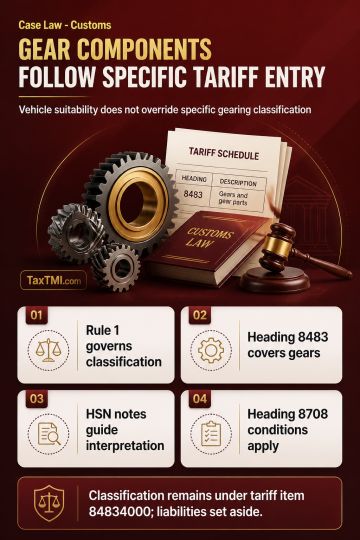
Tariff classification of vehicle gear components follows the specific gearing entry, displacing motor-vehicle parts classification and related liabili...
Necessary-party requirements limit impleadment of independent entities, while deferred consideration does not create an appealable adverse determinati...
Food supplement classification requires common parlance and authoritative tests, preventing treatment as proprietary Ayurvedic medicines without suppo...
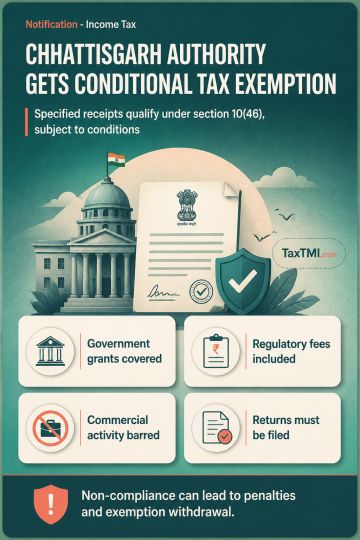
Specified regulatory authority income receives conditional tax exemption, subject to non-commercial activity, unchanged income character, and return f...
Tax exemption for regulatory authority income applies retrospectively, subject to non-commercial activity, unchanged income sources, and return-filing...
In a post-GST construction-linked property transaction, the Tribunal held that phrases such as construction in the post-GST period and upfront payment of the full price do not require the flat to be fully built at agreement stage or payment to be made in one lump sum. It found that where booking, allotment, contracting, construction and payment all occurred during the GST regime, the pricing already reflected the post-GST ITC position, so no separate input tax credit benefit was claimable by the buyers and no locus existed to challenge the DGAP report on that basis. On the merits, the DGAP comparison showed no incremental ITC gain and therefore no contravention of Section 171 read with Rule 129(6).
In a post-GST construction-linked property transaction, the Tribunal held that phrases such as construction in the post-GST period and upfront payment of the full price do not require the flat to be fully built at agreement stage or payment to be made in one lump sum. It found that where booking, allotment, contracting, construction and payment all occurred during the GST regime, the pricing already reflected the post-GST ITC position, so no separate input tax credit benefit was claimable by the buyers and no locus existed to challenge the DGAP report on that basis. On the merits, the DGAP comparison showed no incremental ITC gain and therefore no contravention of Section 171 read with Rule 129(6).
Note: It is a system-generated summary and is for quick reference only.
 TaxTMI
  TaxTMI
 of 4828
















 Join Channel


