GST refunds for cancelled air tickets remain available when passenger reimbursements defeat unjust enrichment and credit-note adjustment is unavailabl...
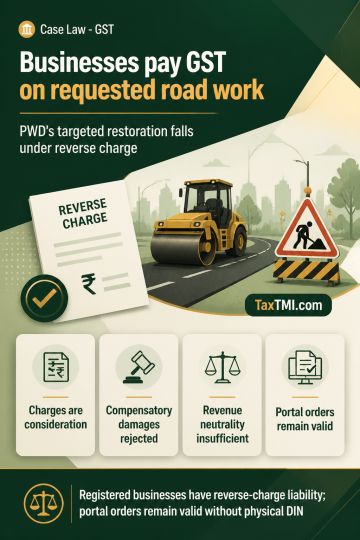
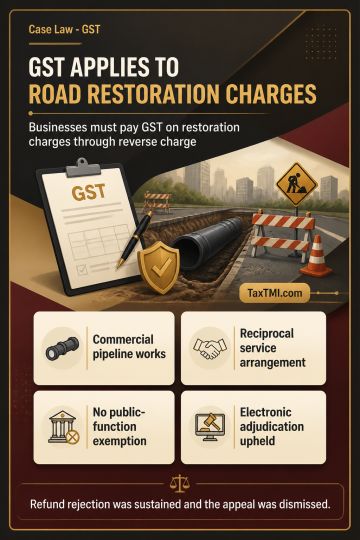
Request-driven road restoration attracts reverse-charge GST, not governmental-function treatment or compensatory-damages status for business recipient...
Road restoration charges for commercial pipeline works are taxable Government services, with reverse charge liability and no public-function exemption...
The ITAT held that settlement payment made under an invoked corporate guarantee was deductible as business expenditure because it arose from commercial expediency. It rejected the Revenue's challenge to the existence of the liability and to the claim that the amount was not incurred wholly and exclusively for business purposes, noting that the arbitration and execution proceedings had already proceeded on the basis of that guarantee. Applying the principle that tax authorities cannot sit in the businessman's armchair to judge commercial expediency, the Tribunal treated the payment as a business outgo and deleted the disallowance.
The ITAT held that settlement payment made under an invoked corporate guarantee was deductible as business expenditure because it arose from commercial expediency. It rejected the Revenue's challenge to the existence of the liability and to the claim that the amount was not incurred wholly and exclusively for business purposes, noting that the arbitration and execution proceedings had already proceeded on the basis of that guarantee. Applying the principle that tax authorities cannot sit in the businessman's armchair to judge commercial expediency, the Tribunal treated the payment as a business outgo and deleted the disallowance.
Note: It is a system-generated summary and is for quick reference only.
 TaxTMI
  TaxTMI
 of 4920