Inherited property sale proceeds require capital-gains treatment where ownership is supported by evidence, not suspicion or unverified signature doubt...
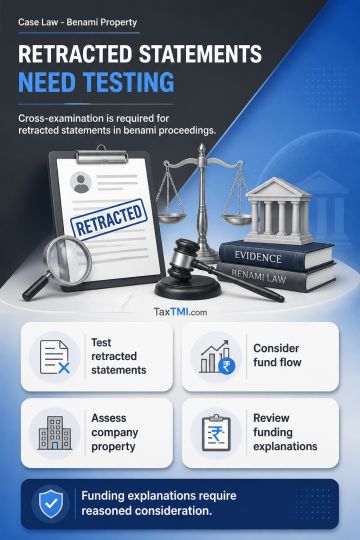
Cross-examination of retracted statements is essential where foundational evidence supports a benami allegation and documented funding explanations re...
Capital-goods exemption covers plant-modernisation accessories, while the import restriction applies only to earlier capital-goods components and spar...
Constitutional judicial review permits challenges to ECIRs and connected money-laundering proceedings where coercive action affects fundamental intere...
Section 32A of the IBC was applied to determine whether...
IBC resolution plan immunity from money-laundering: corporate debtor removed as accused; cases continue against ex-directors, attached assets refunded.
Contents
Summary
Note
Bookmark
Share
✓ Copied successfully !
Print
Print Options
For full text, please login
Login to TaxTMI
Verification Pending
The Email Id has not been verified. Click on the link we have sent on
Section 32A of the IBC was applied to determine whether money-laundering proceedings could continue against a corporate debtor whose resolution plan had been approved and substantially implemented. Since the statutory immunity attaches post-resolution, the corporate debtor was directed to be deleted from the array of accused, while prosecution could continue against erstwhile directors/persons in control and other conspirators/abettors, including confiscation of their own attached assets, if any. The protection was made conditional on the successful resolution applicant being unconnected with prior management and not a beneficiary of proceeds of crime; if investigation undermines this foundation, the enforcement agency may proceed in accordance with law, including questioning the resolution plan. The enforcement agency's challenge to plan approval was closed; it was held to have no right or lien over assets forming part of the approved plan, and deposits were ordered to be refunded with interest. - SC
Section 32A of the IBC was applied to determine whether money-laundering proceedings could continue against a corporate debtor whose resolution plan had been approved and substantially implemented. Since the statutory immunity attaches post-resolution, the corporate debtor was directed to be deleted from the array of accused, while prosecution could continue against erstwhile directors/persons in control and other conspirators/abettors, including confiscation of their own attached assets, if any. The protection was made conditional on the successful resolution applicant being unconnected with prior management and not a beneficiary of proceeds of crime; if investigation undermines this foundation, the enforcement agency may proceed in accordance with law, including questioning the resolution plan. The enforcement agency's challenge to plan approval was closed; it was held to have no right or lien over assets forming part of the approved plan, and deposits were ordered to be refunded with interest. - SC
Note: It is a system-generated summary and is for quick reference only.
 TaxTMI
 of 4784


















 Join Channel


 TaxTMI