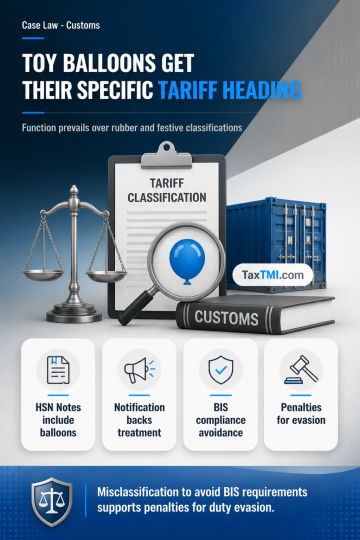
Toy balloon tariff classification: functional heading prevails over residual rubber and festive article headings, supporting penalties for deliberate ...
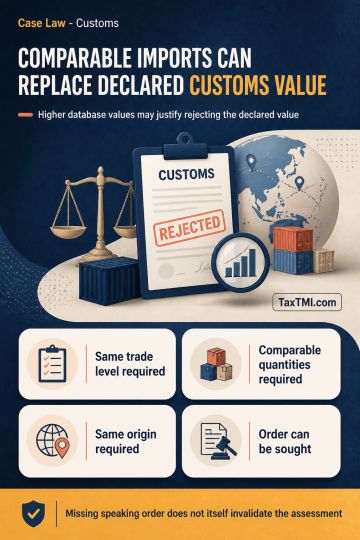
Customs valuation using comparable contemporaneous imports can displace declared value, while missing speaking orders require pursuit before competent...
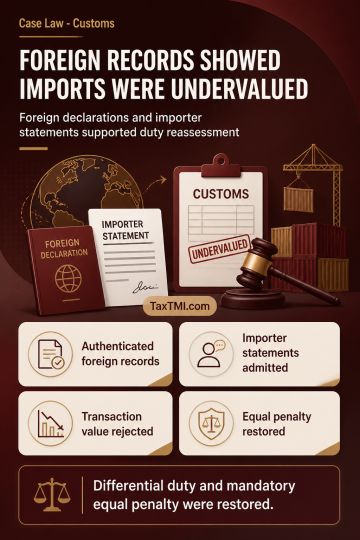
Foreign customs declarations and importer admissions established undervaluation, supporting sequential value redetermination, differential duty, and m...
Customs seizure safeguards prevent detention-based limitation avoidance and invalidate provisional release conditions for imported vehicles under an i...
Page of 4828
Press 'Enter' after typing page number.
361 to 380 of 96556 Results
❮
❯
❯❯
0 / 200
Expand Note
Add to Folder
No Folders have been created
+
Are you sure you want to delete "My most important" ?
AAR held that N/N 134/94-Cus dated 22.06.1994 and the MOOWR scheme, though both operating under s.65 of the Customs Act, 1962, function in distinct domains and their benefits cannot be simultaneously availed for the same imported second-hand goods. The applicant may, however, claim duty exemption under N/N 134/94-Cus for second-hand goods imported for repair, reconditioning, re-engineering, testing, calibration or maintenance, subject to strict compliance with its conditions, including re-export within three years and prior approval of the jurisdictional Principal Commissioner/Commissioner of Customs under s.65. AAR further clarified that valuation and duty treatment of wastage/scrap generated during such operations will be governed by s.65(2), differing based on whether resultant goods are exported or cleared for home consumption.
AAR held that N/N 134/94-Cus dated 22.06.1994 and the MOOWR scheme, though both operating under s.65 of the Customs Act, 1962, function in distinct domains and their benefits cannot be simultaneously availed for the same imported second-hand goods. The applicant may, however, claim duty exemption under N/N 134/94-Cus for second-hand goods imported for repair, reconditioning, re-engineering, testing, calibration or maintenance, subject to strict compliance with its conditions, including re-export within three years and prior approval of the jurisdictional Principal Commissioner/Commissioner of Customs under s.65. AAR further clarified that valuation and duty treatment of wastage/scrap generated during such operations will be governed by s.65(2), differing based on whether resultant goods are exported or cleared for home consumption.
Note: It is a system-generated summary and is for quick reference only.
 TaxTMI
  TaxTMI
 of 4828





 Join Channel