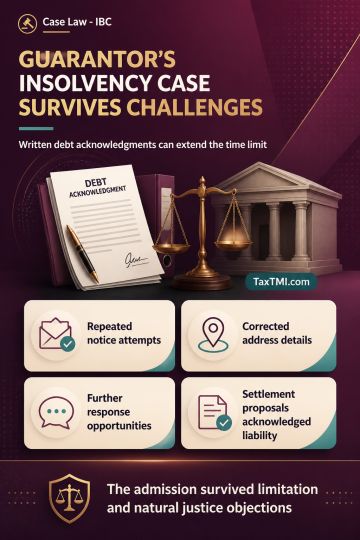
Service of notice and contractual debt acknowledgment preserved insolvency admission against a corporate guarantor despite limitation and natural just...
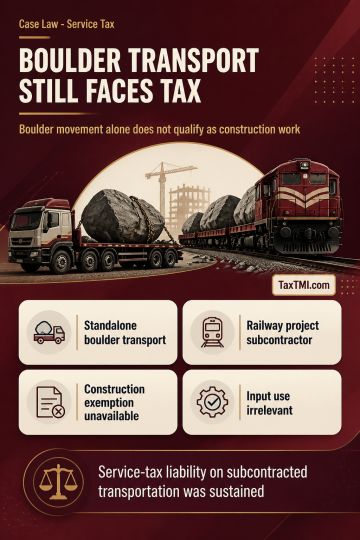
Original works exemption excludes standalone boulder transportation, leaving subcontracted railway-project transport services subject to service tax l...
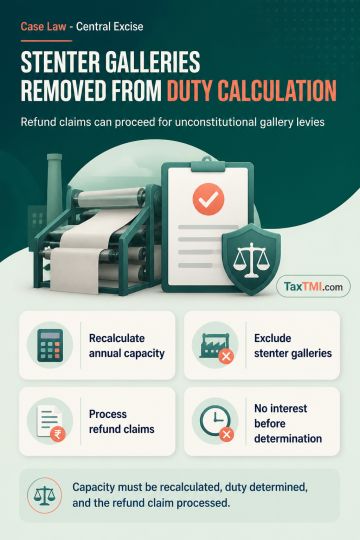
Annual production capacity determinations excluding stenter galleries support refunds for unconstitutional excise levies without an unjust-enrichment ...
Vicarious liability for cheque dishonour requires specific allegations of responsibility and cheque signatory; generic director allegations cannot sus...
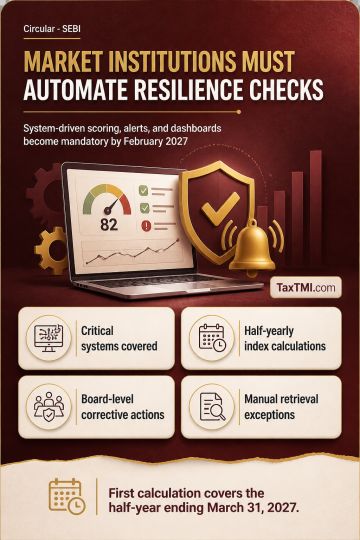
IT Resilience Index requires market infrastructure institutions to automate resilience scoring, early warnings, and continuous service-delivery monito...
AAR held that N/N 134/94-Cus dated 22.06.1994 and the MOOWR scheme, though both operating under s.65 of the Customs Act, 1962, function in distinct domains and their benefits cannot be simultaneously availed for the same imported second-hand goods. The applicant may, however, claim duty exemption under N/N 134/94-Cus for second-hand goods imported for repair, reconditioning, re-engineering, testing, calibration or maintenance, subject to strict compliance with its conditions, including re-export within three years and prior approval of the jurisdictional Principal Commissioner/Commissioner of Customs under s.65. AAR further clarified that valuation and duty treatment of wastage/scrap generated during such operations will be governed by s.65(2), differing based on whether resultant goods are exported or cleared for home consumption.
AAR held that N/N 134/94-Cus dated 22.06.1994 and the MOOWR scheme, though both operating under s.65 of the Customs Act, 1962, function in distinct domains and their benefits cannot be simultaneously availed for the same imported second-hand goods. The applicant may, however, claim duty exemption under N/N 134/94-Cus for second-hand goods imported for repair, reconditioning, re-engineering, testing, calibration or maintenance, subject to strict compliance with its conditions, including re-export within three years and prior approval of the jurisdictional Principal Commissioner/Commissioner of Customs under s.65. AAR further clarified that valuation and duty treatment of wastage/scrap generated during such operations will be governed by s.65(2), differing based on whether resultant goods are exported or cleared for home consumption.
Note: It is a system-generated summary and is for quick reference only.
 TaxTMI
  TaxTMI
 of 4828




 Join Channel