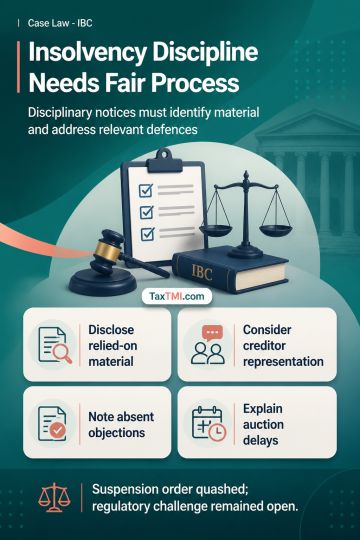
Natural justice in insolvency-professional discipline requires disclosed material; notices based on extraneous material and ignored defences are vitia...
Development rights transfers treated as immovable property, while construction abatement applies and repeated non-payment permits extended service-tax...
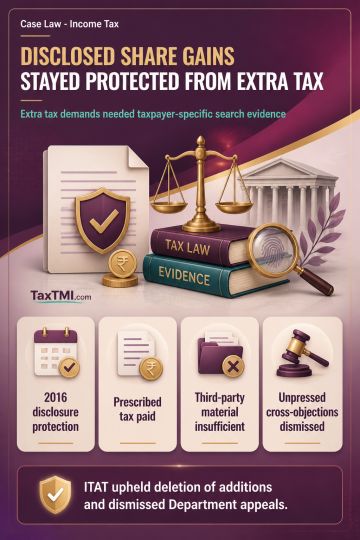
Income Disclosure Scheme immunity and search-material requirements barred further share-transaction additions in unabated assessments under section 15...
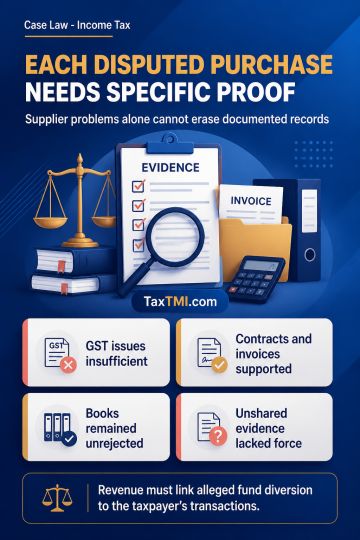
ITAT allowed the assessees' appeals and deleted all additions made under s.153C. Relying on a coordinate bench decision arising from the same search group, ITAT held there was no seized material or statements indicating receipt of cash or other unaccounted consideration, nor any identified payer or corresponding additions in counterparties' hands. It held that in circular transactions, the margin disclosed in the books represents the commission element and, absent incriminating material, no higher income can be estimated on mere presumption. ITAT ruled that s.153C cannot be used for roving reassessment without assessee-specific incriminating material, and that estimated additions based on alleged bogus purchases/sales and enhanced profit rates were unsustainable. The jurisdictional challenge under s.153C was rendered academic.
ITAT allowed the assessees' appeals and deleted all additions made under s.153C. Relying on a coordinate bench decision arising from the same search group, ITAT held there was no seized material or statements indicating receipt of cash or other unaccounted consideration, nor any identified payer or corresponding additions in counterparties' hands. It held that in circular transactions, the margin disclosed in the books represents the commission element and, absent incriminating material, no higher income can be estimated on mere presumption. ITAT ruled that s.153C cannot be used for roving reassessment without assessee-specific incriminating material, and that estimated additions based on alleged bogus purchases/sales and enhanced profit rates were unsustainable. The jurisdictional challenge under s.153C was rendered academic.
Note: It is a system-generated summary and is for quick reference only.
 TaxTMI
  TaxTMI
 of 4828








 Join Channel