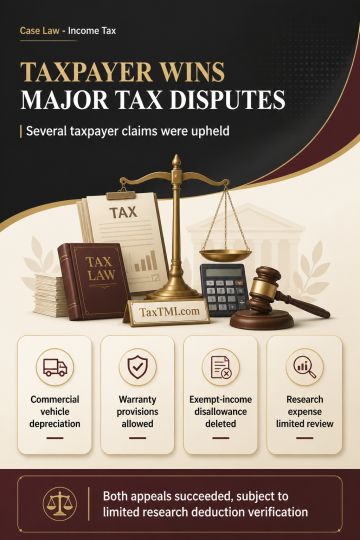
Commercial vehicle depreciation, scientifically determined warranty provisions and exempt-income disallowances were resolved in favour of the taxpayer...
Inherited property sale proceeds require capital-gains treatment where ownership is supported by evidence, not suspicion or unverified signature doubt...
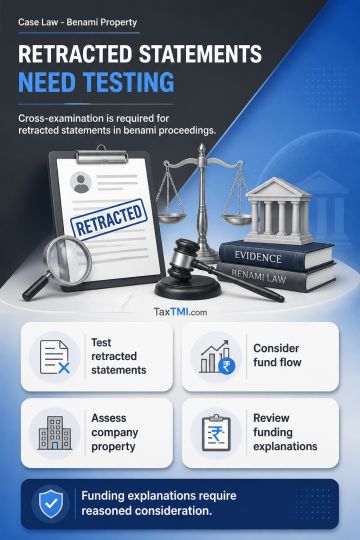
Cross-examination of retracted statements is essential where foundational evidence supports a benami allegation and documented funding explanations re...
Capital-goods exemption covers plant-modernisation accessories, while the import restriction applies only to earlier capital-goods components and spar...
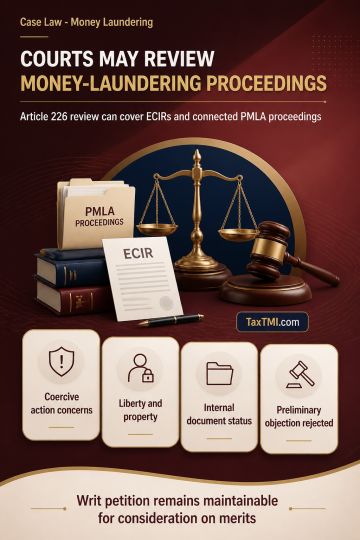
Constitutional judicial review permits challenges to ECIRs and connected money-laundering proceedings where coercive action affects fundamental intere...
CESTAT held that the seizure of 20 gold biscuits from Appellant A lacked the "reasonable belief" required under s.110(1) of the Customs Act, 1962, as the Dept. failed to establish foreign origin or smuggled character of the goods. Mere foreign markings, doubtful purity, city "town seizure" far from any border, and incomplete testing were found insufficient to prove illicit import. Consequently, s.123 was held inapplicable, and the burden of proof did not shift to Appellant A; the Dept. remained obliged to prove smuggling, which it failed to do. Confiscation under s.111(b) and (d) and penalties under s.112(b)(ii) were set aside. The impugned order was quashed and the appeal of Appellant A was allowed, with consequential relief.
CESTAT held that the seizure of 20 gold biscuits from Appellant A lacked the "reasonable belief" required under s.110(1) of the Customs Act, 1962, as the Dept. failed to establish foreign origin or smuggled character of the goods. Mere foreign markings, doubtful purity, city "town seizure" far from any border, and incomplete testing were found insufficient to prove illicit import. Consequently, s.123 was held inapplicable, and the burden of proof did not shift to Appellant A; the Dept. remained obliged to prove smuggling, which it failed to do. Confiscation under s.111(b) and (d) and penalties under s.112(b)(ii) were set aside. The impugned order was quashed and the appeal of Appellant A was allowed, with consequential relief.
Note: It is a system-generated summary and is for quick reference only.
 TaxTMI
 of 4780










 Join Channel


 TaxTMI
