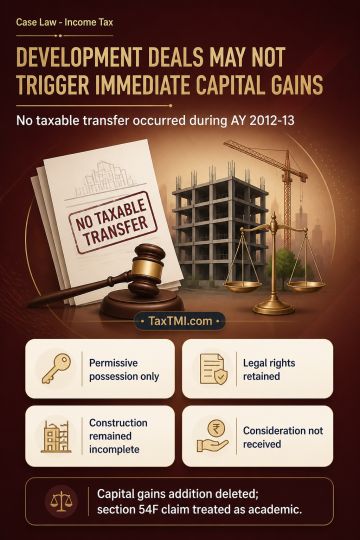
Development agreements require legal possession or effective enjoyment for capital gains transfer; permissive possession and deferred consideration de...
Prolonged sterilisation of development rights supports capital-gains treatment, while business-income disallowances cannot govern capital-gains comput...
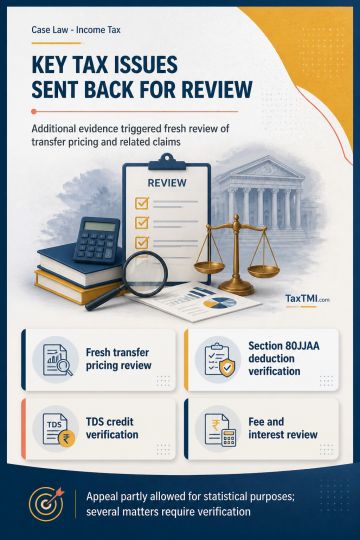
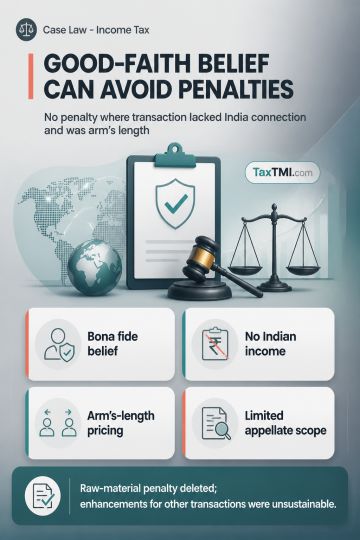
Additional evidence in transfer pricing dispute leads to fresh examination, while tax deductions, TDS credit, fee and refund interest require verifica...
Category II AIF pass-through taxation preserves non-business income character; investment receipts cannot be reclassified without applying recognised ...
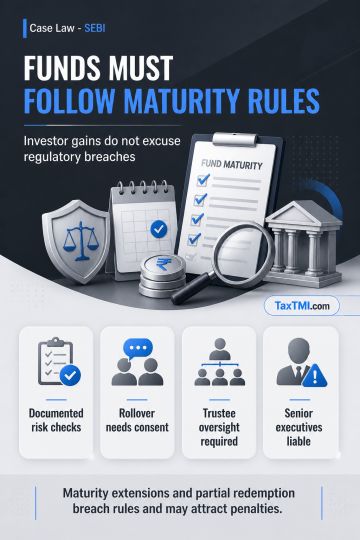
Mutual fund maturity rules require proper rollover, redemption, disclosure, and due diligence; investor gains cannot excuse regulatory breaches or pen...
SC held that key provisions of the Tribunal Reforms Act, 2021, including those on minimum age, curtailed tenure, upper age caps, panel selection process, and equivalence of service conditions with civil servants, are unconstitutional. The Court found that Parliament had impermissibly reenacted, in altered form, provisions previously struck down, without curing the constitutional defects, amounting to a legislative override of binding judicial directions. Such measures were held violative of constitutional supremacy, separation of powers, judicial independence, and Article 14. SC clarified that while Parliament may enact curative legislation, it cannot disregard or nullify prior judicial pronouncements. The offending provisions were struck down, with protection extended to affected tribunal members whose appointments had been delayed and improperly subjected to the new regime. Petitions were disposed of.
SC held that key provisions of the Tribunal Reforms Act, 2021, including those on minimum age, curtailed tenure, upper age caps, panel selection process, and equivalence of service conditions with civil servants, are unconstitutional. The Court found that Parliament had impermissibly reenacted, in altered form, provisions previously struck down, without curing the constitutional defects, amounting to a legislative override of binding judicial directions. Such measures were held violative of constitutional supremacy, separation of powers, judicial independence, and Article 14. SC clarified that while Parliament may enact curative legislation, it cannot disregard or nullify prior judicial pronouncements. The offending provisions were struck down, with protection extended to affected tribunal members whose appointments had been delayed and improperly subjected to the new regime. Petitions were disposed of.
Note: It is a system-generated summary and is for quick reference only.
 TaxTMI
 of 4794












 Join Channel


 TaxTMI
