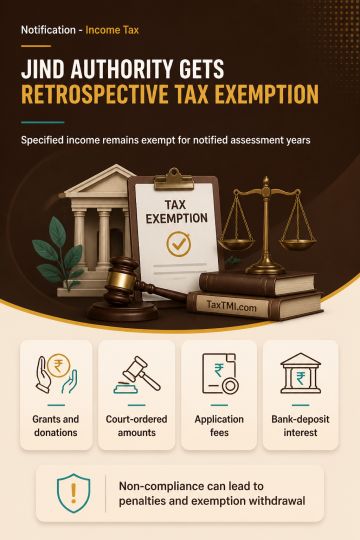
Tax exemption for specified legal-services authority income applies retrospectively, subject to non-commercial activity, unchanged income sources, and...
Approved resolution plans extinguish unsubmitted pre-approval tax claims, preventing later recovery outside the insolvency process and preserving a cl...
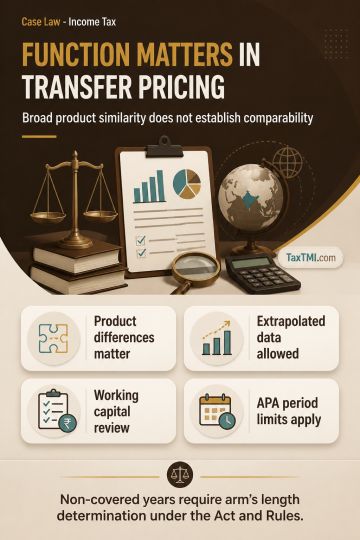
Transfer pricing comparability requires functional alignment and permits working capital adjustment, while APA margins cannot govern non-covered years...
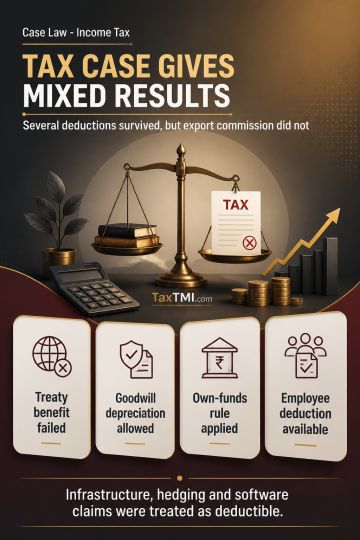
Treaty benefit, goodwill depreciation and hedging costs: export commission disallowed, while key business deductions and depreciation claims succeeded...
Page of 4790
Press 'Enter' after typing page number.
681 to 700 of 95794 Results
❮
❯
❯❯
0 / 200
Expand Note
Add to Folder
No Folders have been created
+
Are you sure you want to delete "My most important" ?
SC held that key provisions of the Tribunal Reforms Act, 2021, including those on minimum age, curtailed tenure, upper age caps, panel selection process, and equivalence of service conditions with civil servants, are unconstitutional. The Court found that Parliament had impermissibly reenacted, in altered form, provisions previously struck down, without curing the constitutional defects, amounting to a legislative override of binding judicial directions. Such measures were held violative of constitutional supremacy, separation of powers, judicial independence, and Article 14. SC clarified that while Parliament may enact curative legislation, it cannot disregard or nullify prior judicial pronouncements. The offending provisions were struck down, with protection extended to affected tribunal members whose appointments had been delayed and improperly subjected to the new regime. Petitions were disposed of.
SC held that key provisions of the Tribunal Reforms Act, 2021, including those on minimum age, curtailed tenure, upper age caps, panel selection process, and equivalence of service conditions with civil servants, are unconstitutional. The Court found that Parliament had impermissibly reenacted, in altered form, provisions previously struck down, without curing the constitutional defects, amounting to a legislative override of binding judicial directions. Such measures were held violative of constitutional supremacy, separation of powers, judicial independence, and Article 14. SC clarified that while Parliament may enact curative legislation, it cannot disregard or nullify prior judicial pronouncements. The offending provisions were struck down, with protection extended to affected tribunal members whose appointments had been delayed and improperly subjected to the new regime. Petitions were disposed of.
Note: It is a system-generated summary and is for quick reference only.
 TaxTMI
 of 4790







 Join Channel


 TaxTMI