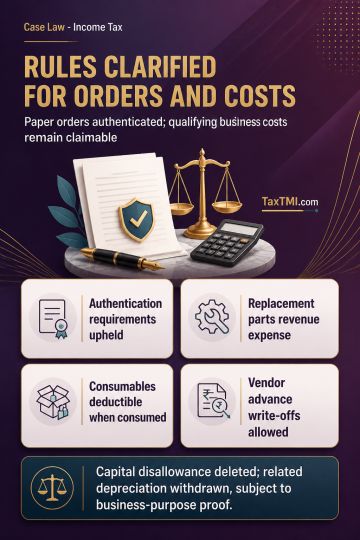
Authentication of paper assessment orders upheld, while qualifying repairs, consumables and vendor advance write-offs remain deductible business claim...
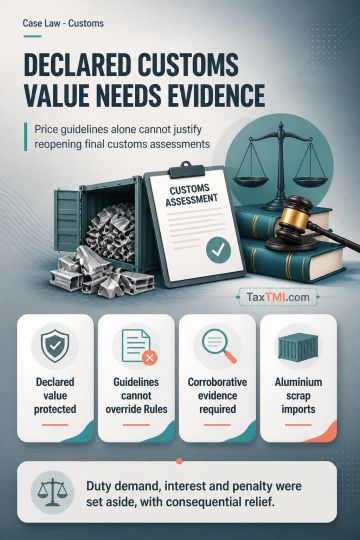
Transaction value cannot be rejected solely on non-statutory valuation guidelines without corroborative evidence supporting reassessment of final cust...
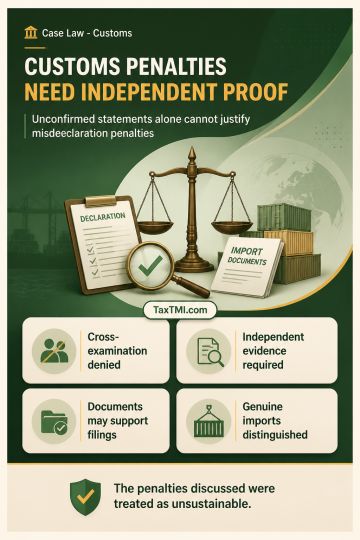
Cross-examination rights and corroborated evidence limit customs penalties for misdeclaration in genuine import transactions involving documented clea...
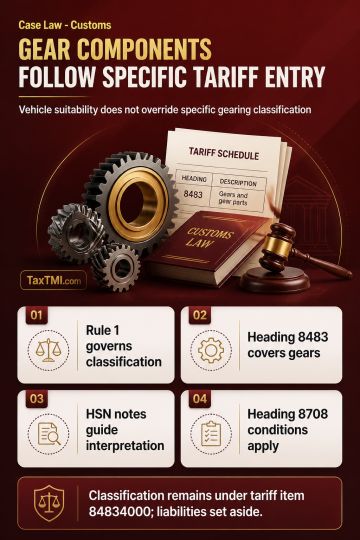
Tariff classification of vehicle gear components follows the specific gearing entry, displacing motor-vehicle parts classification and related liabili...
The tax board notifies that communications sent via the customs department's eOffice public option bearing an automatically generated verifiable "Issue number" will be treated as the Document Identification Number (DIN), since a new online verification utility confirms issue number, file number, date, document type and masked recipient details; officers must accurately populate metadata when creating documents. DIN remains mandatory for communications not sent via eOffice public option or lacking a verifiable reference number on the GST portal. Earlier circulars requiring separate DINs are modified to this extent.
The tax board notifies that communications sent via the customs department's eOffice public option bearing an automatically generated verifiable "Issue number" will be treated as the Document Identification Number (DIN), since a new online verification utility confirms issue number, file number, date, document type and masked recipient details; officers must accurately populate metadata when creating documents. DIN remains mandatory for communications not sent via eOffice public option or lacking a verifiable reference number on the GST portal. Earlier circulars requiring separate DINs are modified to this extent.
Note: It is a system-generated summary and is for quick reference only.
 TaxTMI
 of 4805












 Join Channel


 TaxTMI