Business expenditure deduction requires proof of genuine commission payments and commercial allowability; turnover growth alone cannot validate the cl...
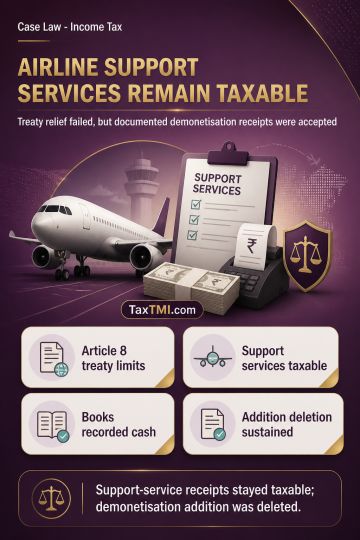
Article 8 treaty coverage excluded third-party airline support services, while documented demonetisation cash receipts remained accepted business inco...
Functional comparability under TNMM requires highway contract benchmarks to reflect operation, maintenance and transfer activities, requiring fresh be...
The tax board notifies that communications sent via the customs department's eOffice public option bearing an automatically generated verifiable "Issue number" will be treated as the Document Identification Number (DIN), since a new online verification utility confirms issue number, file number, date, document type and masked recipient details; officers must accurately populate metadata when creating documents. DIN remains mandatory for communications not sent via eOffice public option or lacking a verifiable reference number on the GST portal. Earlier circulars requiring separate DINs are modified to this extent.
The tax board notifies that communications sent via the customs department's eOffice public option bearing an automatically generated verifiable "Issue number" will be treated as the Document Identification Number (DIN), since a new online verification utility confirms issue number, file number, date, document type and masked recipient details; officers must accurately populate metadata when creating documents. DIN remains mandatory for communications not sent via eOffice public option or lacking a verifiable reference number on the GST portal. Earlier circulars requiring separate DINs are modified to this extent.
Note: It is a system-generated summary and is for quick reference only.
 TaxTMI
 of 4803
















 Join Channel


 TaxTMI