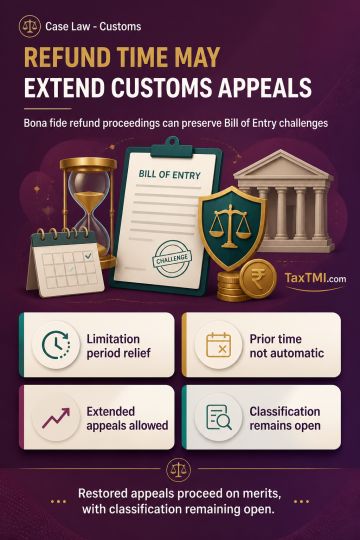
Limitation in customs appeals permits exclusion for bona fide refund proceedings, enabling restoration of Bill of Entry assessment challenges on merit...
Warehousing permission requires deposit at the designated bonded warehouse; unauthorised diversion triggers confiscation, redemption fine and importer...
The HC dismissed the petition challenging action under section 129(3) of the GST Act, holding that although an e-way bill was ultimately produced before the seizure and penalty orders, it was not generated contemporaneously with movement and was created after interception (at 1:19 p.m.), evidencing non-compliance with statutory requirements; accordingly, the court found no basis to infer absence of intent to evade tax or to disturb the impugned orders. The court applied its prior ratio and upheld the seizure and penalty, concluding that, on the facts and in law, no interference with the administrative orders was warranted.
The HC dismissed the petition challenging action under section 129(3) of the GST Act, holding that although an e-way bill was ultimately produced before the seizure and penalty orders, it was not generated contemporaneously with movement and was created after interception (at 1:19 p.m.), evidencing non-compliance with statutory requirements; accordingly, the court found no basis to infer absence of intent to evade tax or to disturb the impugned orders. The court applied its prior ratio and upheld the seizure and penalty, concluding that, on the facts and in law, no interference with the administrative orders was warranted.
Note: It is a system-generated summary and is for quick reference only.
 TaxTMI
 of 4794













 Join Channel


 TaxTMI