Political contribution deductions require genuine transactions; banking records and party registration alone cannot defeat evidence of accommodation e...
Post-death GST liability permits fresh proceedings against legal representatives, while discontinued-business recovery remains limited to the inherite...
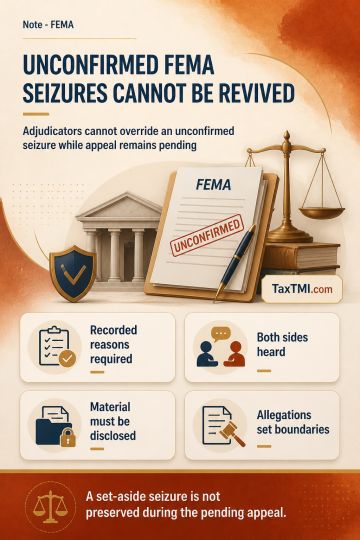
Non-confirmation of FEMA seizure prevents adjudicators from overriding pending appellate findings on recorded reasons and suspected foreign asset hold...
The HC dismissed the petition challenging action under section 129(3) of the GST Act, holding that although an e-way bill was ultimately produced before the seizure and penalty orders, it was not generated contemporaneously with movement and was created after interception (at 1:19 p.m.), evidencing non-compliance with statutory requirements; accordingly, the court found no basis to infer absence of intent to evade tax or to disturb the impugned orders. The court applied its prior ratio and upheld the seizure and penalty, concluding that, on the facts and in law, no interference with the administrative orders was warranted.
The HC dismissed the petition challenging action under section 129(3) of the GST Act, holding that although an e-way bill was ultimately produced before the seizure and penalty orders, it was not generated contemporaneously with movement and was created after interception (at 1:19 p.m.), evidencing non-compliance with statutory requirements; accordingly, the court found no basis to infer absence of intent to evade tax or to disturb the impugned orders. The court applied its prior ratio and upheld the seizure and penalty, concluding that, on the facts and in law, no interference with the administrative orders was warranted.
Note: It is a system-generated summary and is for quick reference only.
 TaxTMI
  TaxTMI