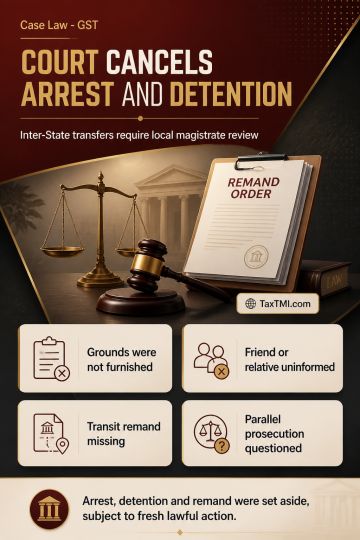
Arrest safeguards and transit remand requirements invalidated detention following inter-State transfer without communicated grounds or magistrate auth...
Arrest safeguards require disclosed grounds, relative intimation and transit remand, while duplicate prosecution under the CGST framework is unsustain...
Document Identification Number defects can invalidate GST assessments, with delayed challenges entertained conditionally where patent irregularities e...
Windmill commissioning evidence supported higher depreciation where grid connection and electricity generation proved operational use before the relev...
Pharmaceutical promotion and transfer-pricing comparability principles limited disallowances, while uncorroborated search allegations and unsupported ...
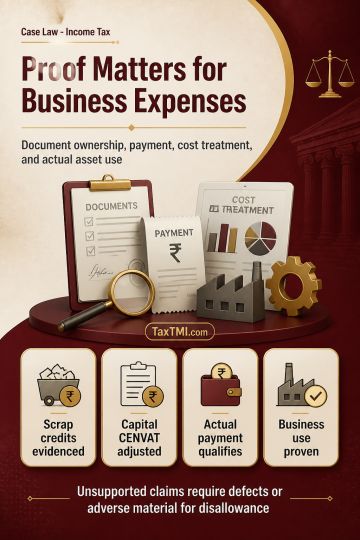
Business expenditure substantiation supports scrap credits, statutory payments and expense claims, while depreciation requires proof of actual busines...
Page of 4794
Press 'Enter' after typing page number.
621 to 640 of 95875 Results
❮
❯
❯❯
0 / 200
Expand Note
Add to Folder
No Folders have been created
+
Are you sure you want to delete "My most important" ?
The HC held that a cash loan of Rs. 5 lakhs, though in violation of Section 269SS of the IT Act, does not negate its status as a legally enforceable debt under Section 138 of the NI Act. The Trial Court's finding that the loan was unenforceable due to non-compliance with Section 269SS was overturned. The accused admitted signing the cheque, triggering the statutory presumption under Section 139 of the NI Act. The claim that the cheque was blank when issued did not discharge the accused's burden to rebut the presumption. Allegations of forgery were dismissed as minor clerical corrections without prejudice. Consequently, the accused failed to rebut the presumption of liability, and the essential ingredients of the offence under Section 138 NI Act were established. The conviction under Section 138 NI Act was restored, the Trial Court's judgment set aside, and the matter was remanded for sentencing.
The HC held that a cash loan of Rs. 5 lakhs, though in violation of Section 269SS of the IT Act, does not negate its status as a legally enforceable debt under Section 138 of the NI Act. The Trial Court's finding that the loan was unenforceable due to non-compliance with Section 269SS was overturned. The accused admitted signing the cheque, triggering the statutory presumption under Section 139 of the NI Act. The claim that the cheque was blank when issued did not discharge the accused's burden to rebut the presumption. Allegations of forgery were dismissed as minor clerical corrections without prejudice. Consequently, the accused failed to rebut the presumption of liability, and the essential ingredients of the offence under Section 138 NI Act were established. The conviction under Section 138 NI Act was restored, the Trial Court's judgment set aside, and the matter was remanded for sentencing.
Note: It is a system-generated summary and is for quick reference only.
 TaxTMI
 of 4794


















 Join Channel


 TaxTMI