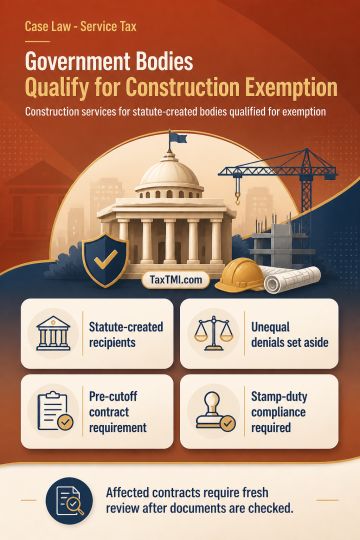
Governmental authority status supports construction-service exemption, while pre-cutoff contract and stamp-duty compliance requires verification on re...
Automated Free Sale and Commerce Certificates enable paperless processing while retaining risk-based manual verification for selected exporter applica...
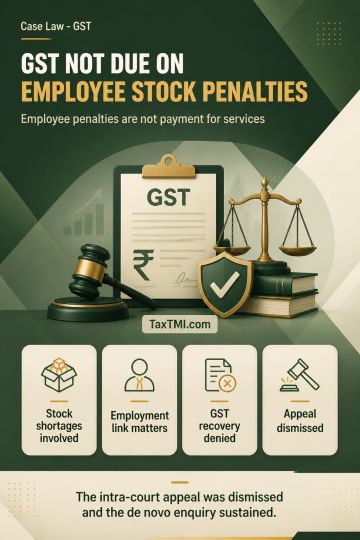
Employee stock-shortage penalties do not constitute consideration for services, preventing GST collection under Schedule II in employment relationship...
The HC upheld the dismissal of the appellant's writ petition, affirming that a compounding application cannot be entertained after the adjudicating authority has passed its order. Compounding requires a prior voluntary admission of contravention, which becomes redundant once guilt is adjudicated. The appellant's second compounding application, filed post-adjudication and lacking mandatory disclosure of the adjudicating authority, was rightly rejected. The Court emphasized that allowing compounding after final adjudication would undermine the statutory scheme designed to ensure timely penalty recovery under the Act. The appellant's contention regarding uncertainty about the proper authority before adjudication was dismissed as unfounded. Consequently, the appeal failed and was dismissed, confirming that compounding is only permissible prior to the conclusion of the adjudication process.
The HC upheld the dismissal of the appellant's writ petition, affirming that a compounding application cannot be entertained after the adjudicating authority has passed its order. Compounding requires a prior voluntary admission of contravention, which becomes redundant once guilt is adjudicated. The appellant's second compounding application, filed post-adjudication and lacking mandatory disclosure of the adjudicating authority, was rightly rejected. The Court emphasized that allowing compounding after final adjudication would undermine the statutory scheme designed to ensure timely penalty recovery under the Act. The appellant's contention regarding uncertainty about the proper authority before adjudication was dismissed as unfounded. Consequently, the appeal failed and was dismissed, confirming that compounding is only permissible prior to the conclusion of the adjudication process.
Note: It is a system-generated summary and is for quick reference only.
 TaxTMI
  TaxTMI
 of 4828









 Join Channel


