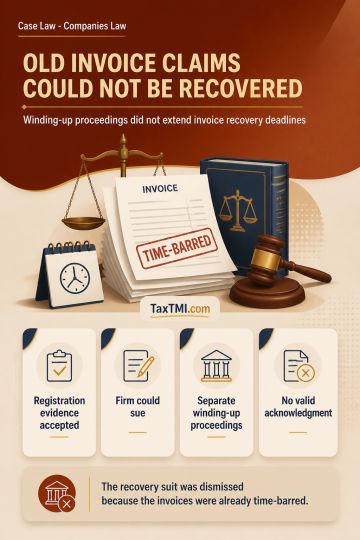
Invoice-based recovery claims remain time-barred despite separate winding-up proceedings, absent valid acknowledgment or part-payment of the disputed ...
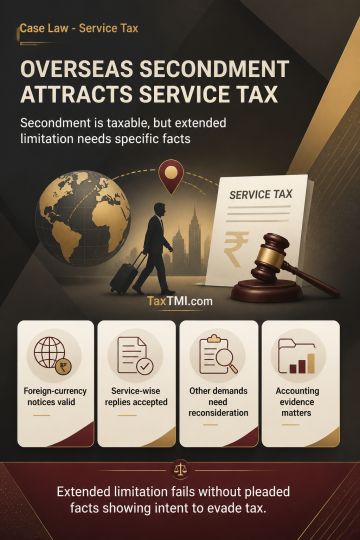
Extended limitation fails without specific suppression allegations, while overseas employee secondment remains taxable as manpower supply within norma...
Time-share accommodation classification excludes Club or Association Service where purchasers receive contractual occupancy rights without genuine mem...
CENVAT credit for trading requires reversal, while taxable-service rental credit remains proportionately available and limitation issues await resolut...
Page of 4792
Press 'Enter' after typing page number.
61 to 80 of 95833 Results
❮
❯
❯❯
0 / 200
Expand Note
Add to Folder
No Folders have been created
+
Are you sure you want to delete "My most important" ?
The AAR held that the applicant's supply does not constitute a "pure service" as defined under Notification No. 12/2017-Central Tax (Rate) dated 28.06.2017, since the consideration received included both the procurement value of goods and service charges without segregation. The applicant failed to satisfy clause (d) of the relevant explanation, which requires distinct treatment of procurement costs separate from service charges to qualify as a pure agent. Consequently, the supply cannot be classified as a pure service, rendering the applicant ineligible for the exemption under Sl. No. 3 of the said notification. The ruling confirms that when goods and services are bundled without clear separation of values, the exemption for pure services does not apply.
The AAR held that the applicant's supply does not constitute a "pure service" as defined under Notification No. 12/2017-Central Tax (Rate) dated 28.06.2017, since the consideration received included both the procurement value of goods and service charges without segregation. The applicant failed to satisfy clause (d) of the relevant explanation, which requires distinct treatment of procurement costs separate from service charges to qualify as a pure agent. Consequently, the supply cannot be classified as a pure service, rendering the applicant ineligible for the exemption under Sl. No. 3 of the said notification. The ruling confirms that when goods and services are bundled without clear separation of values, the exemption for pure services does not apply.
Note: It is a system-generated summary and is for quick reference only.
 TaxTMI
 of 4792










 Join Channel


 TaxTMI

