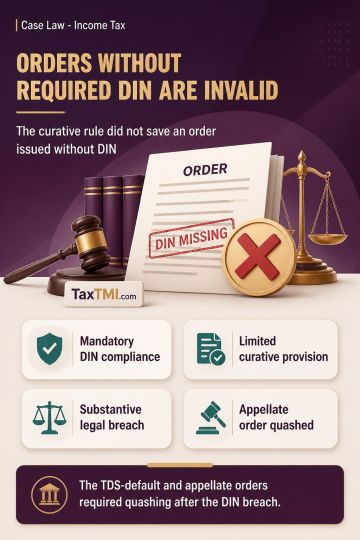
Document Identification Number compliance renders TDS-default orders invalid where mandatory DIN requirements are breached and curative provision does...
The CESTAT upheld the principle that the phrase "for use in manufacture" in notification No. 21/2002 Cus. cannot be interpreted to exclude inputs that are destroyed or not physically incorporated into the final product from remission eligibility. Relying on precedent from a Coordinate Bench, the Tribunal held that such a restrictive interpretation would render Rule 21 of the Central Excise Rules and Section 23 of the Customs Act, 1962 ineffective, which is impermissible. Since no contrary modification or setting aside of the precedent was demonstrated, the impugned order denying remission for alleged violation of end-use conditions was quashed. Consequently, the appeal was allowed, and the impugned order was set aside.
The CESTAT upheld the principle that the phrase "for use in manufacture" in notification No. 21/2002 Cus. cannot be interpreted to exclude inputs that are destroyed or not physically incorporated into the final product from remission eligibility. Relying on precedent from a Coordinate Bench, the Tribunal held that such a restrictive interpretation would render Rule 21 of the Central Excise Rules and Section 23 of the Customs Act, 1962 ineffective, which is impermissible. Since no contrary modification or setting aside of the precedent was demonstrated, the impugned order denying remission for alleged violation of end-use conditions was quashed. Consequently, the appeal was allowed, and the impugned order was set aside.
Note: It is a system-generated summary and is for quick reference only.
 TaxTMI
  TaxTMI
 of 4918