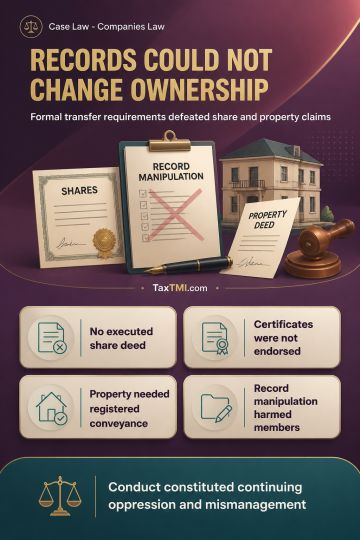
Statutory transfer formalities invalidated alleged share and property transfers, while retrospective record manipulation constituted oppression and mi...
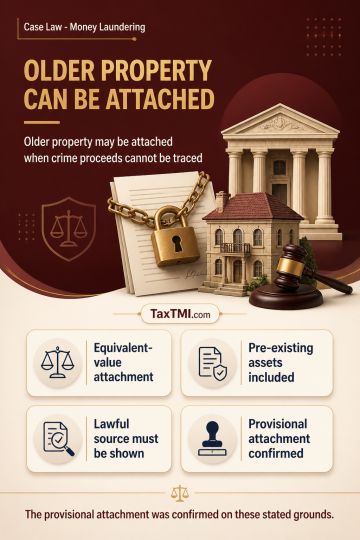
Provisional attachment of laundered funds and equivalent-value property sustained, with statutory protection limited to pension, gratuity and providen...
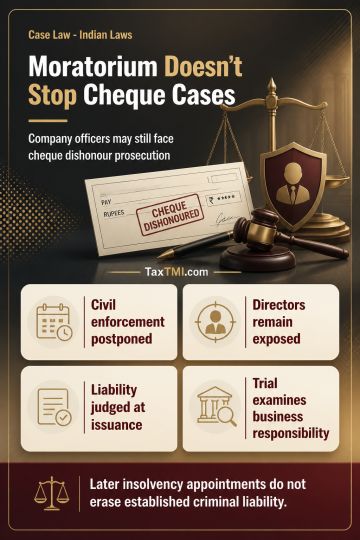
Insolvency moratorium does not shield company officers from cheque dishonour prosecution for liability arising before corporate insolvency proceedings...
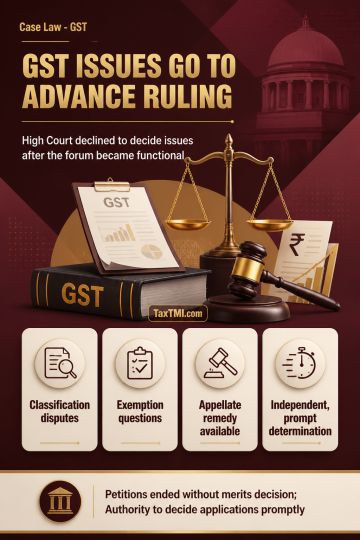
Advance-ruling mechanism governs pending GST classification, exemption and taxability disputes, limiting writ review once the specialised forum functi...
Page of 4805
Press 'Enter' after typing page number.
921 to 940 of 96092 Results
❮
❯
❯❯
0 / 200
Expand Note
Add to Folder
No Folders have been created
+
Are you sure you want to delete "My most important" ?
The HC dismissed the challenge to the vires of Sections 69 and 132 of the CGST Act, 2017, which confer power to arrest and prescribe punishment, holding that the contention lacked merit in light of the recent Supreme Court decision in Radhika Agarwal v. Union of India. The SC upheld the constitutional validity of these provisions, affirming that Article 246A grants Parliament exclusive legislative competence over GST, including anti-evasion measures. Consequently, the HC found no violation of Articles 14, 20, or 21 of the Constitution and rejected the petitions contesting the legality of Sections 69 and 132. All related writ petitions were disposed of accordingly, with the application being dismissed.
The HC dismissed the challenge to the vires of Sections 69 and 132 of the CGST Act, 2017, which confer power to arrest and prescribe punishment, holding that the contention lacked merit in light of the recent Supreme Court decision in Radhika Agarwal v. Union of India. The SC upheld the constitutional validity of these provisions, affirming that Article 246A grants Parliament exclusive legislative competence over GST, including anti-evasion measures. Consequently, the HC found no violation of Articles 14, 20, or 21 of the Constitution and rejected the petitions contesting the legality of Sections 69 and 132. All related writ petitions were disposed of accordingly, with the application being dismissed.
Note: It is a system-generated summary and is for quick reference only.
 TaxTMI
 of 4805







 Join Channel


 TaxTMI