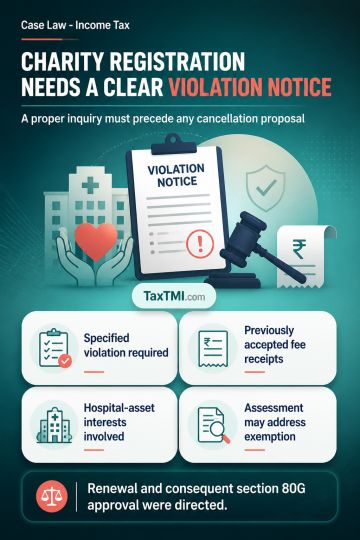
Charitable trust registration requires a specified-violation notice; settled cash deposits and related-party payments did not justify cancellation or ...
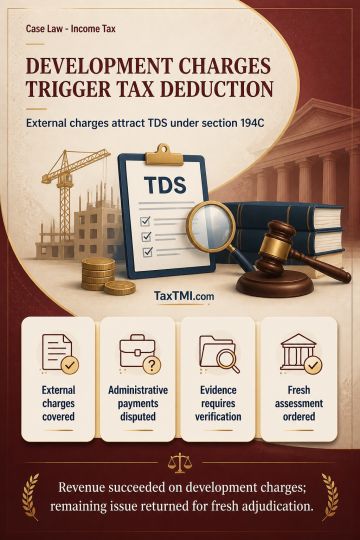
External development charges trigger TDS under section 194C, while disputed administrative payments require factual verification and fresh adjudicatio...
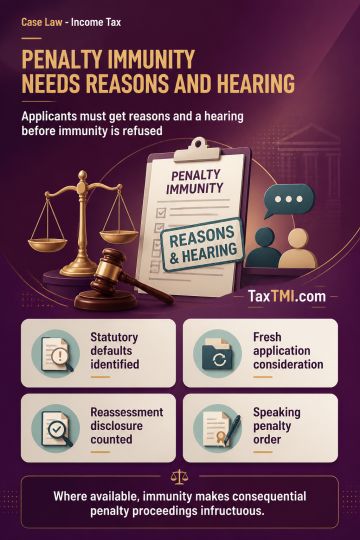
Section 270AA penalty immunity requires identified statutory defaults and a hearing before rejection; reassessment disclosure may constitute under-rep...
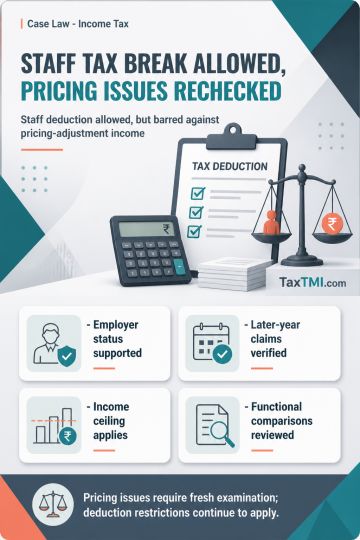
Section 80JJAA employee-cost deduction allowed for deployed staff but barred against transfer-pricing income enhancement, with pricing issues remanded...
Transfer-pricing methodology protects commercially genuine associated-enterprise payments, while pre-2016 secondary adjustments and related notional i...
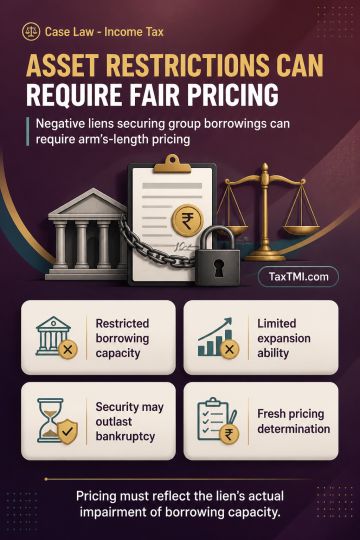
Negative liens over operating assets can constitute international transactions requiring arm's-length pricing reflecting restricted borrowing and expa...
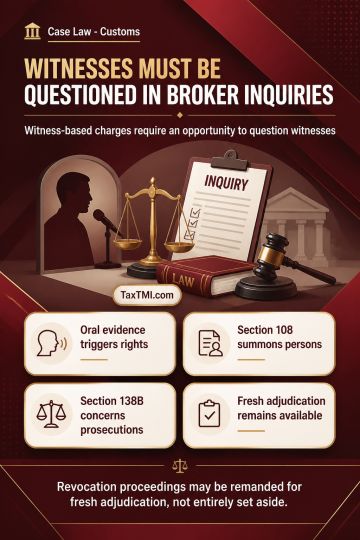
Cross-examination rights in Customs Broker revocation inquiries require witness examination; procedural denial may be cured through fresh adjudication...
The HC held that a dissolved company remains liable for offences committed prior to dissolution, as per Section 250 of the Companies Act and Sections 70 and 71 of the PMLA Act. Such a company can be prosecuted by restoring it under Section 305 Cr.P.C or, if restoration is not feasible, by prosecuting a director or authorized representative as its representative. The court affirmed that designating a director as the representative of the dissolved company in criminal proceedings under Sections 420, 120B IPC, and Sections 13(2), 13(1)(d) Prevention of Corruption Act is justified in the interest of justice. The petition challenging the order refusing to remove the petitioner as the company's representative was dismissed, confirming the Special Court's decision and upholding the prosecution's approach to ensure accountability despite the company's dissolution.
The HC held that a dissolved company remains liable for offences committed prior to dissolution, as per Section 250 of the Companies Act and Sections 70 and 71 of the PMLA Act. Such a company can be prosecuted by restoring it under Section 305 Cr.P.C or, if restoration is not feasible, by prosecuting a director or authorized representative as its representative. The court affirmed that designating a director as the representative of the dissolved company in criminal proceedings under Sections 420, 120B IPC, and Sections 13(2), 13(1)(d) Prevention of Corruption Act is justified in the interest of justice. The petition challenging the order refusing to remove the petitioner as the company's representative was dismissed, confirming the Special Court's decision and upholding the prosecution's approach to ensure accountability despite the company's dissolution.
Note: It is a system-generated summary and is for quick reference only.
 TaxTMI
  TaxTMI
 of 4828















 Join Channel


