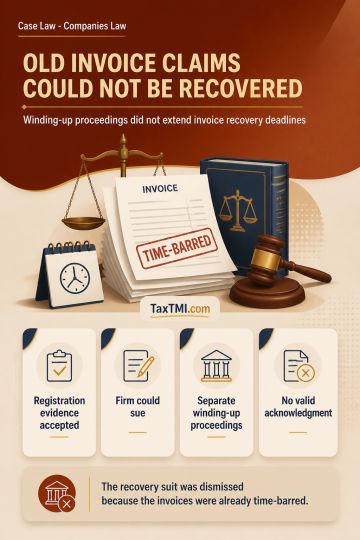
Invoice-based recovery claims remain time-barred despite separate winding-up proceedings, absent valid acknowledgment or part-payment of the disputed ...
Extended limitation fails without specific suppression allegations, while overseas employee secondment remains taxable as manpower supply within norma...
Time-share accommodation classification excludes Club or Association Service where purchasers receive contractual occupancy rights without genuine mem...
CENVAT credit for trading requires reversal, while taxable-service rental credit remains proportionately available and limitation issues await resolut...
Vicarious liability for dishonoured company cheques may extend to non-signatory directors where complaints contain foundational responsibility avermen...
The HC dismissed the petition seeking modification of the order adjudicating a composite SCN against the Petitioners and challenging the vires of N/N. 06/2020-Central Tax. The Court held that under Section 2(4) of the CGST Act, the Adjudicating Authority excludes the Appellate Authority, which has full power to consider the matter afresh on appeal under Section 107. The adjudication order was detailed and considered the Petitioners' submissions, including those related to multiple financial years. The legislative intent prohibits remanding the matter back to ensure finality, but the Appellate Authority may confirm, modify, or annul the order on merits. Reliance on precedents affirmed the wide scope of appellate powers under Section 107(11). Consequently, the Court declined to interfere and dismissed the application for modification.
The HC dismissed the petition seeking modification of the order adjudicating a composite SCN against the Petitioners and challenging the vires of N/N. 06/2020-Central Tax. The Court held that under Section 2(4) of the CGST Act, the Adjudicating Authority excludes the Appellate Authority, which has full power to consider the matter afresh on appeal under Section 107. The adjudication order was detailed and considered the Petitioners' submissions, including those related to multiple financial years. The legislative intent prohibits remanding the matter back to ensure finality, but the Appellate Authority may confirm, modify, or annul the order on merits. Reliance on precedents affirmed the wide scope of appellate powers under Section 107(11). Consequently, the Court declined to interfere and dismissed the application for modification.
Note: It is a system-generated summary and is for quick reference only.
 TaxTMI
 of 4803

















 Join Channel


 TaxTMI