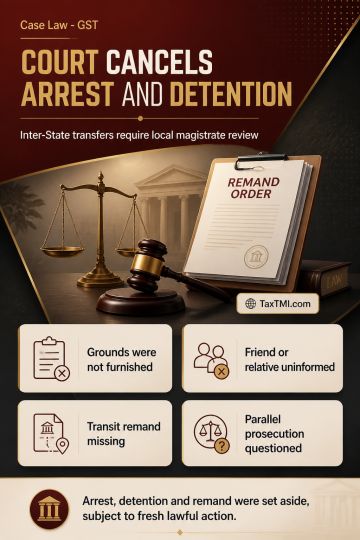
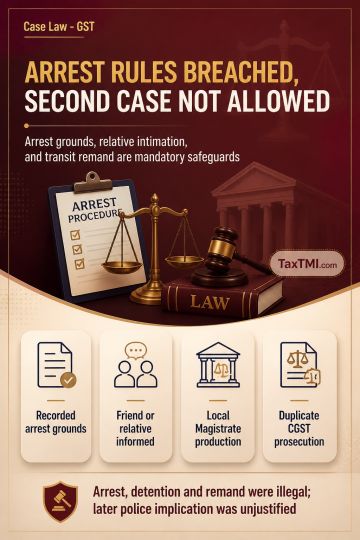
Arrest safeguards and transit remand requirements invalidated detention following inter-State transfer without communicated grounds or magistrate auth...
Arrest safeguards require disclosed grounds, relative intimation and transit remand, while duplicate prosecution under the CGST framework is unsustain...
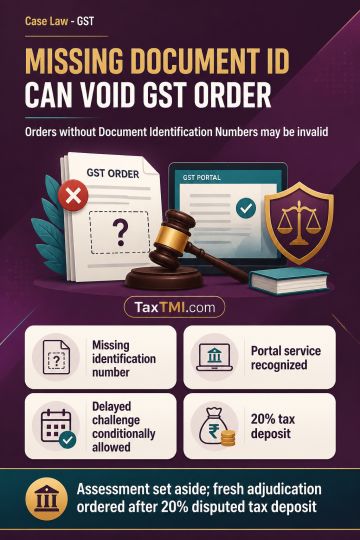
Document Identification Number defects can invalidate GST assessments, with delayed challenges entertained conditionally where patent irregularities e...
Windmill commissioning evidence supported higher depreciation where grid connection and electricity generation proved operational use before the relev...
Pharmaceutical promotion and transfer-pricing comparability principles limited disallowances, while uncorroborated search allegations and unsupported ...
The HC upheld the assessee's claim for depreciation on revalued assets based on the actual cost paid to the erstwhile partners, rejecting the denial under Explanation 3 to Section 43(1). The court clarified that Rule 5 of the Income Tax Rules, 1962, limits aggregate depreciation to the actual cost of the asset, which, in this case, corresponds to the valuation agreed upon in April 1982 when the original partnership was reconstituted. Despite the dissolution of the original firm in 1984 and changes in partnership, the assessee is entitled to claim depreciation for subsequent years on the actual cost paid. The court further held that familial relationships among partners do not affect this entitlement under the Act. The questions of law were decided in favor of the assessee, affirming the right to depreciation on the revalued asset cost.
The HC upheld the assessee's claim for depreciation on revalued assets based on the actual cost paid to the erstwhile partners, rejecting the denial under Explanation 3 to Section 43(1). The court clarified that Rule 5 of the Income Tax Rules, 1962, limits aggregate depreciation to the actual cost of the asset, which, in this case, corresponds to the valuation agreed upon in April 1982 when the original partnership was reconstituted. Despite the dissolution of the original firm in 1984 and changes in partnership, the assessee is entitled to claim depreciation for subsequent years on the actual cost paid. The court further held that familial relationships among partners do not affect this entitlement under the Act. The questions of law were decided in favor of the assessee, affirming the right to depreciation on the revalued asset cost.
Note: It is a system-generated summary and is for quick reference only.
 TaxTMI
 of 4782

















 Join Channel


 TaxTMI
