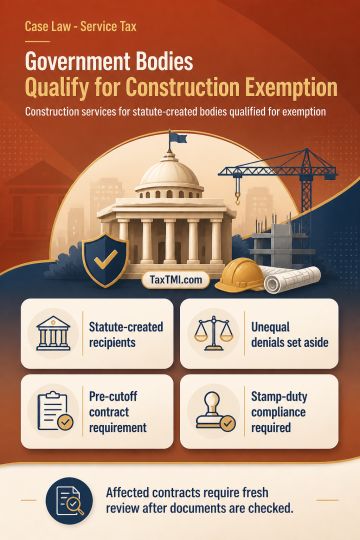
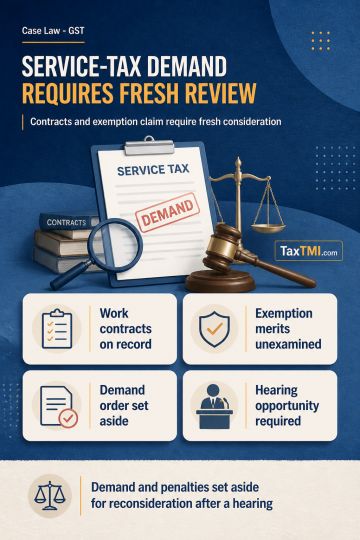
Governmental authority status supports construction-service exemption, while pre-cutoff contract and stamp-duty compliance requires verification on re...
Automated Free Sale and Commerce Certificates enable paperless processing while retaining risk-based manual verification for selected exporter applica...
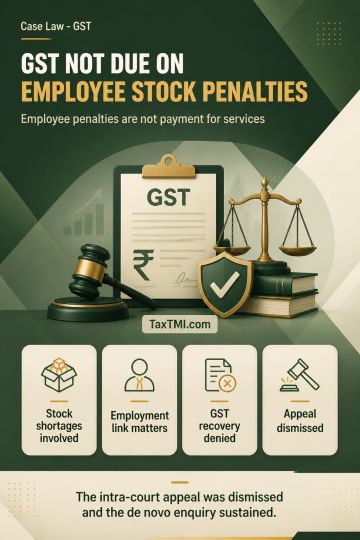
Employee stock-shortage penalties do not constitute consideration for services, preventing GST collection under Schedule II in employment relationship...
The HC held that payments made by appellant to parent company in normal course of business as commercial transactions do not constitute deemed dividend under section 2(22)(e). The court relied on precedential decisions from Punjab and Haryana HC and Delhi HC, which established that trade advances made for business expediency are not treated as advances attracting deemed dividend provisions. The Supreme Court's dismissal of revenue's appeal against Punjab and Haryana HC judgment reinforced this position. Subsequently, CBDT issued Circular No.19 of 2017 acknowledging this settled legal position, directing department officers not to file appeals on this ground and withdraw existing ones. The HC concluded that ITAT's remand order was uncalled for and any consequential orders detrimental to assessee would be rendered bad in law, effectively settling the issue in favor of taxpayer.
The HC held that payments made by appellant to parent company in normal course of business as commercial transactions do not constitute deemed dividend under section 2(22)(e). The court relied on precedential decisions from Punjab and Haryana HC and Delhi HC, which established that trade advances made for business expediency are not treated as advances attracting deemed dividend provisions. The Supreme Court's dismissal of revenue's appeal against Punjab and Haryana HC judgment reinforced this position. Subsequently, CBDT issued Circular No.19 of 2017 acknowledging this settled legal position, directing department officers not to file appeals on this ground and withdraw existing ones. The HC concluded that ITAT's remand order was uncalled for and any consequential orders detrimental to assessee would be rendered bad in law, effectively settling the issue in favor of taxpayer.
Note: It is a system-generated summary and is for quick reference only.
 TaxTMI
  TaxTMI
 of 4828









 Join Channel


