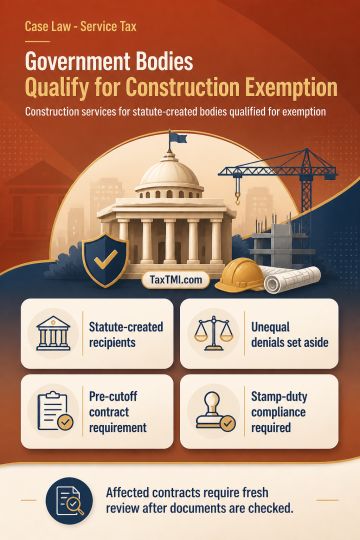
Governmental authority status supports construction-service exemption, while pre-cutoff contract and stamp-duty compliance requires verification on re...
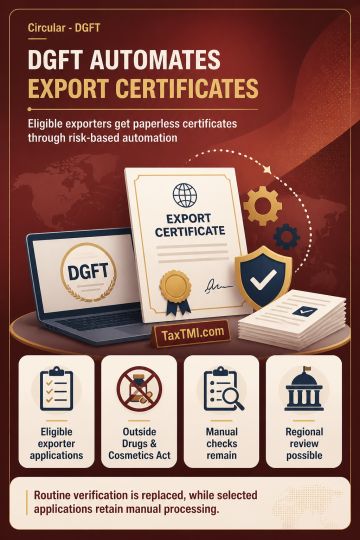
Automated Free Sale and Commerce Certificates enable paperless processing while retaining risk-based manual verification for selected exporter applica...
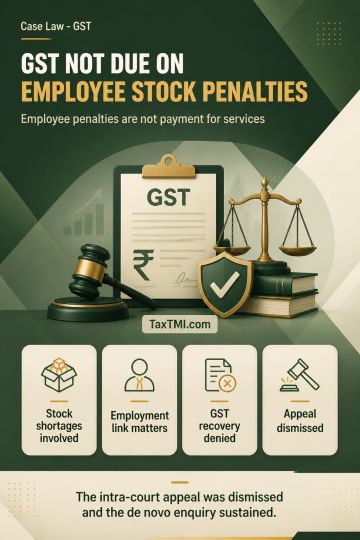
Employee stock-shortage penalties do not constitute consideration for services, preventing GST collection under Schedule II in employment relationship...
CESTAT ruled that lithium-ion batteries imported for mobile...
Lithium-ion batteries for mobile phone manufacturing qualify for 12% IGST under Serial No. 203, specific end-use provisions override general classification rules.
Contents
Summary
Note
Bookmark
Share
✓ Copied successfully !
Print
Print Options
For full text, please login
Login to TaxTMI
Verification Pending
The Email Id has not been verified. Click on the link we have sent on
CESTAT ruled that lithium-ion batteries imported for mobile phone manufacturing qualify for IGST at 12% under Serial No. 203 of Schedule II to IGST Rate Notification No. 01/2017-IT (Rate) from 01.04.2018 to 31.03.2020, thereafter 18% following omission of Serial No. 203. The Tribunal rejected revenue's contention that batteries should attract higher rates under Serial No. 139 (28%) or Serial No. 376AA (18%) based on classification uncertainty at import stage. Relying on precedents including LG Electronics and Camlin Ltd., CESTAT held that specific end-use provisions override general classification rules. The demand for short-paid customs duty under Section 28(1) of Customs Act, interest under Section 28AA, redemption fine, and penalty under Section 112(a)(ii) were set aside. Appeal allowed.
CESTAT ruled that lithium-ion batteries imported for mobile phone manufacturing qualify for IGST at 12% under Serial No. 203 of Schedule II to IGST Rate Notification No. 01/2017-IT (Rate) from 01.04.2018 to 31.03.2020, thereafter 18% following omission of Serial No. 203. The Tribunal rejected revenue's contention that batteries should attract higher rates under Serial No. 139 (28%) or Serial No. 376AA (18%) based on classification uncertainty at import stage. Relying on precedents including LG Electronics and Camlin Ltd., CESTAT held that specific end-use provisions override general classification rules. The demand for short-paid customs duty under Section 28(1) of Customs Act, interest under Section 28AA, redemption fine, and penalty under Section 112(a)(ii) were set aside. Appeal allowed.
Note: It is a system-generated summary and is for quick reference only.
 TaxTMI
  TaxTMI
 of 4828






 Join Channel


