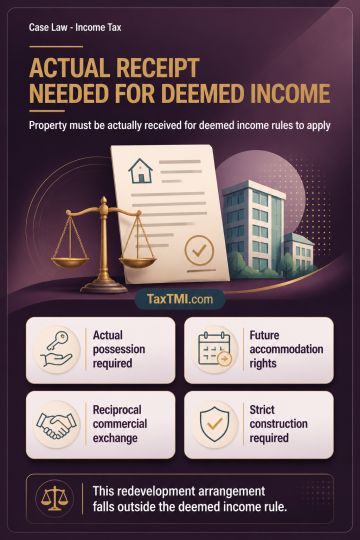
Receipt of immovable property requires actual possession or enjoyment; redevelopment allotments exchanged for tenancy rights fall outside deemed incom...
Section 80P deduction covers Souharda credit societies, including qualifying surplus-deposit interest, subject to member KYC verification for cash dep...
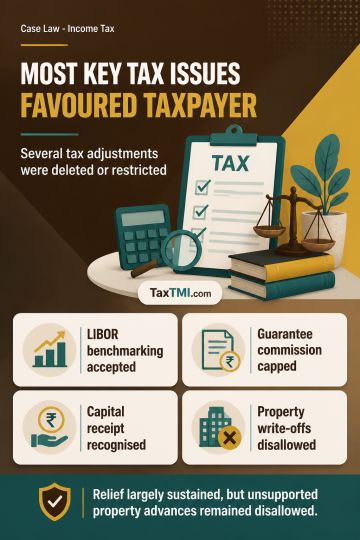
Transfer-pricing benchmarking and capital-receipt principles sustained taxpayer relief, while unsupported property-advance write-offs remained disallo...
HC set aside penalty imposed under Section 129(3) of the Goods and Services Tax Act, ruling that mens rea is sine qua non for penalty imposition. The petitioner generated e-way bill after detention, with tax already paid, demonstrating no intent to evade tax. Court held that authorities cannot presume tax evasion based solely on procedural lapses such as expired e-way bills, particularly when valid reasons exist. The judgment emphasized that penalty proceedings require proof of intentional tax evasion, not mere technical violations. Respondent authorities failed to establish requisite intent or provide adequate reasoning for penalty imposition. Petition allowed, impugned order quashed for lacking foundational grounds regarding evasion intent.
HC set aside penalty imposed under Section 129(3) of the Goods and Services Tax Act, ruling that mens rea is sine qua non for penalty imposition. The petitioner generated e-way bill after detention, with tax already paid, demonstrating no intent to evade tax. Court held that authorities cannot presume tax evasion based solely on procedural lapses such as expired e-way bills, particularly when valid reasons exist. The judgment emphasized that penalty proceedings require proof of intentional tax evasion, not mere technical violations. Respondent authorities failed to establish requisite intent or provide adequate reasoning for penalty imposition. Petition allowed, impugned order quashed for lacking foundational grounds regarding evasion intent.
Note: It is a system-generated summary and is for quick reference only.
 TaxTMI
 of 4805













 Join Channel


 TaxTMI
