Current account treatment of overseas tournament services removed most FEMA findings, but excess EEFC remittance and delayed repatriation remained bre...
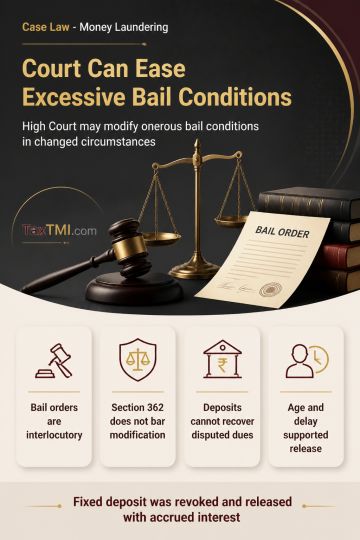
Modification of bail conditions remains available through inherent jurisdiction where onerous deposits undermine justice and cannot recover disputed d...
Merchant banker regulation consolidates registration, governance, capital, reporting, outsourcing and investor-protection requirements under an update...
HC set aside penalty imposed under Section 129(3) of the Goods and Services Tax Act, ruling that mens rea is sine qua non for penalty imposition. The petitioner generated e-way bill after detention, with tax already paid, demonstrating no intent to evade tax. Court held that authorities cannot presume tax evasion based solely on procedural lapses such as expired e-way bills, particularly when valid reasons exist. The judgment emphasized that penalty proceedings require proof of intentional tax evasion, not mere technical violations. Respondent authorities failed to establish requisite intent or provide adequate reasoning for penalty imposition. Petition allowed, impugned order quashed for lacking foundational grounds regarding evasion intent.
HC set aside penalty imposed under Section 129(3) of the Goods and Services Tax Act, ruling that mens rea is sine qua non for penalty imposition. The petitioner generated e-way bill after detention, with tax already paid, demonstrating no intent to evade tax. Court held that authorities cannot presume tax evasion based solely on procedural lapses such as expired e-way bills, particularly when valid reasons exist. The judgment emphasized that penalty proceedings require proof of intentional tax evasion, not mere technical violations. Respondent authorities failed to establish requisite intent or provide adequate reasoning for penalty imposition. Petition allowed, impugned order quashed for lacking foundational grounds regarding evasion intent.
Note: It is a system-generated summary and is for quick reference only.
 TaxTMI
 of 4803












 Join Channel


 TaxTMI