Service of notice and contractual debt acknowledgment preserved insolvency admission against a corporate guarantor despite limitation and natural just...
Original works exemption excludes standalone boulder transportation, leaving subcontracted railway-project transport services subject to service tax l...
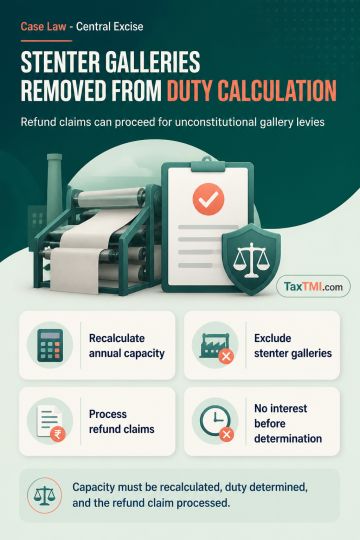
Annual production capacity determinations excluding stenter galleries support refunds for unconstitutional excise levies without an unjust-enrichment ...
Vicarious liability for cheque dishonour requires specific allegations of responsibility and cheque signatory; generic director allegations cannot sus...
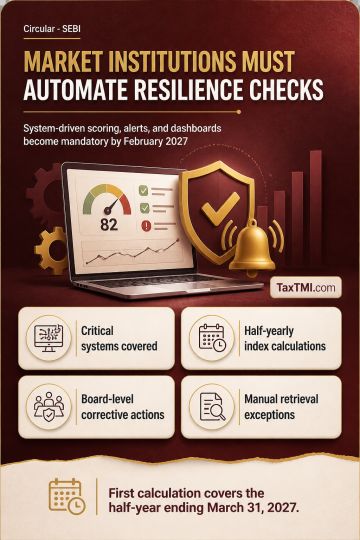
IT Resilience Index requires market infrastructure institutions to automate resilience scoring, early warnings, and continuous service-delivery monito...
ITAT addressed differential turnover where assessee declared lower turnover compared to Form 26QB and audit report Form 3CA. AO added entire differential amount to total income. CIT(A) restricted addition to profit element at 15% of differential receipts. ITAT held that since assessee's P&L Account reflected net material consumption considering opening/closing work-in-progress, entire differential amount cannot constitute income. Given assessee's declared gross profit rate of 16.22%, ITAT modified CIT(A)'s order directing AO to compute income using 16.22% gross profit rate instead of 15%. Revenue's appeal partly allowed with profit computation adjusted to reflect assessee's actual gross profit margin rather than CIT(A)'s conservative estimate.
ITAT addressed differential turnover where assessee declared lower turnover compared to Form 26QB and audit report Form 3CA. AO added entire differential amount to total income. CIT(A) restricted addition to profit element at 15% of differential receipts. ITAT held that since assessee's P&L Account reflected net material consumption considering opening/closing work-in-progress, entire differential amount cannot constitute income. Given assessee's declared gross profit rate of 16.22%, ITAT modified CIT(A)'s order directing AO to compute income using 16.22% gross profit rate instead of 15%. Revenue's appeal partly allowed with profit computation adjusted to reflect assessee's actual gross profit margin rather than CIT(A)'s conservative estimate.
Note: It is a system-generated summary and is for quick reference only.
 TaxTMI
  TaxTMI
 of 4828












 Join Channel