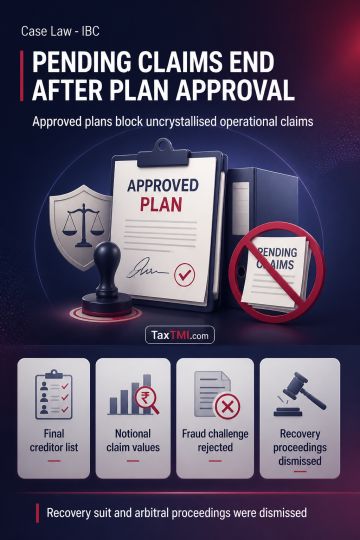
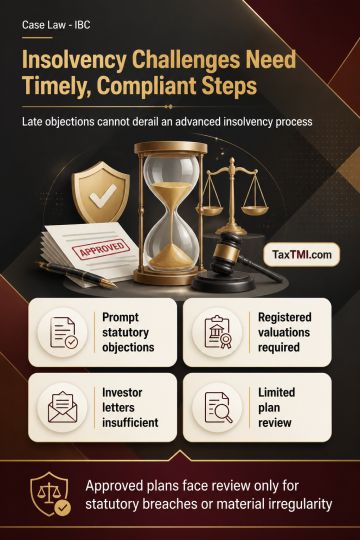
Clean slate principle extinguishes uncrystallised operational claims and bars continuation of pending recovery and arbitral proceedings after plan app...
Works contract classification governs composite layout-development contracts where VAT-paid goods are transferred alongside construction and infrastru...
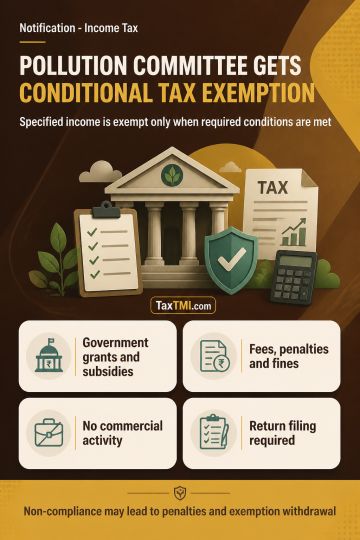
Specified income tax exemption for pollution control body remains conditional on non-commercial activity, unchanged income character, and return filin...
Page of 4803
Press 'Enter' after typing page number.
1061 to 1080 of 96046 Results
❮
❯
❯❯
0 / 200
Expand Note
Add to Folder
No Folders have been created
+
Are you sure you want to delete "My most important" ?
The HC allowed the revision application in a dishonour of cheque case under Section 138 of the Negotiable Instruments Act. The complainant, a company director, filed the complaint in his individual capacity without proper authorization or power of attorney from the company. The agreement was executed between two companies, requiring the complainant to represent the company rather than act personally. While lack of authorization constitutes a curable defect per Supreme Court precedent in M.M.T.C. Ltd. v. Medchl Chemicals, the company failed to rectify this defect at any subsequent stage. The Court held that authorized persons must file complaints on behalf of and in the name of the principal, not in their personal capacity, making the complaint legally impermissible.
The HC allowed the revision application in a dishonour of cheque case under Section 138 of the Negotiable Instruments Act. The complainant, a company director, filed the complaint in his individual capacity without proper authorization or power of attorney from the company. The agreement was executed between two companies, requiring the complainant to represent the company rather than act personally. While lack of authorization constitutes a curable defect per Supreme Court precedent in M.M.T.C. Ltd. v. Medchl Chemicals, the company failed to rectify this defect at any subsequent stage. The Court held that authorized persons must file complaints on behalf of and in the name of the principal, not in their personal capacity, making the complaint legally impermissible.
Note: It is a system-generated summary and is for quick reference only.
 TaxTMI
 of 4803







 Join Channel


 TaxTMI
