Development agreements require legal possession or effective enjoyment for capital gains transfer; permissive possession and deferred consideration de...
Prolonged sterilisation of development rights supports capital-gains treatment, while business-income disallowances cannot govern capital-gains comput...
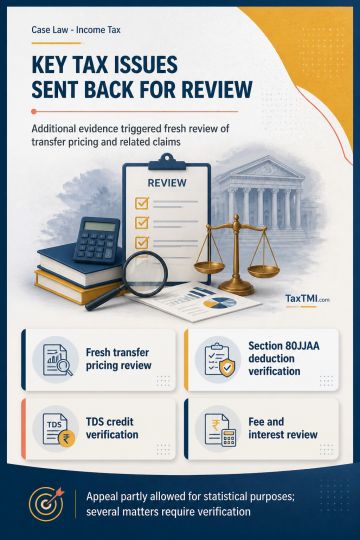
Additional evidence in transfer pricing dispute leads to fresh examination, while tax deductions, TDS credit, fee and refund interest require verifica...
Category II AIF pass-through taxation preserves non-business income character; investment receipts cannot be reclassified without applying recognised ...
Mutual fund maturity rules require proper rollover, redemption, disclosure, and due diligence; investor gains cannot excuse regulatory breaches or pen...
Page of 4798
Press 'Enter' after typing page number.
1161 to 1180 of 95957 Results
❮
❯
❯❯
0 / 200
Expand Note
Add to Folder
No Folders have been created
+
Are you sure you want to delete "My most important" ?
CESTAT held that Section 11B(2)(c) and (d) do not provide for refund of unutilized cenvat credit upon factory closure. Rule 5 of Cenvat Credit Rules, 2004 permits refund only for export-related scenarios, not for manufacturing cessation. The appellant's contentions were rejected, finding no statutory basis for cash refund of accumulated credit. The tribunal emphasized that equitable considerations cannot override explicit statutory provisions. Despite potential financial hardship, the claim was deemed untenable as the regulations do not permit such refunds. Consequently, the appeal was dismissed, reinforcing a strict interpretation of tax credit refund regulations.
CESTAT held that Section 11B(2)(c) and (d) do not provide for refund of unutilized cenvat credit upon factory closure. Rule 5 of Cenvat Credit Rules, 2004 permits refund only for export-related scenarios, not for manufacturing cessation. The appellant's contentions were rejected, finding no statutory basis for cash refund of accumulated credit. The tribunal emphasized that equitable considerations cannot override explicit statutory provisions. Despite potential financial hardship, the claim was deemed untenable as the regulations do not permit such refunds. Consequently, the appeal was dismissed, reinforcing a strict interpretation of tax credit refund regulations.
Note: It is a system-generated summary and is for quick reference only.
 TaxTMI
 of 4798
















 Join Channel


 TaxTMI