Specialized Investment Fund distribution now requires dedicated certification, while transitional recognition preserves existing qualified distributor...
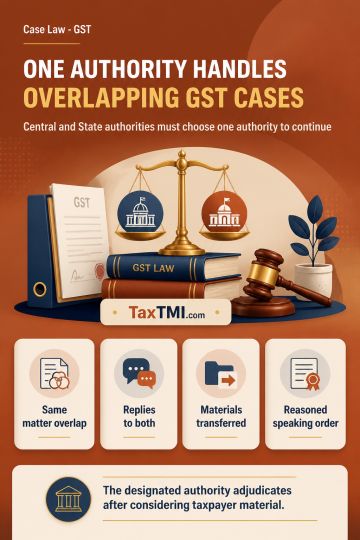
Overlapping GST proceedings require Central and State authorities to designate one competent authority for coordinated adjudication of the same matter...
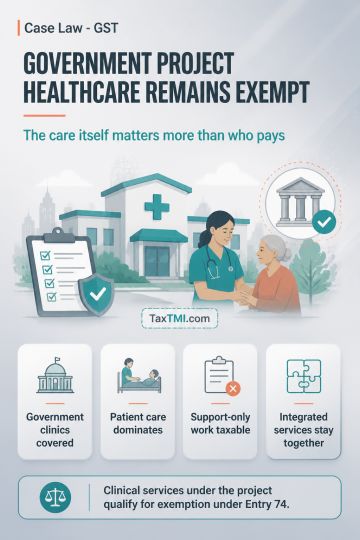
Composite healthcare supplies retain exemption when patient care is the contract's essential character, despite payment through an implementing agency...
The AAR held that the GST rate for the project is governed by the one-time option exercised by the original promoter at 12% with input tax credit. The applicant is bound by this project-specific election and cannot switch to a 5% rate without input tax credit. The ruling emphasizes that the tax treatment is project-based, not promoter-specific. Consequently, the applicant must discharge GST at 18% (9% CGST + 9% SGST) with input tax credit, applying a one-third deduction for land value. The option applies uniformly to existing and new buyers, preventing differential tax rates within the same project.
The AAR held that the GST rate for the project is governed by the one-time option exercised by the original promoter at 12% with input tax credit. The applicant is bound by this project-specific election and cannot switch to a 5% rate without input tax credit. The ruling emphasizes that the tax treatment is project-based, not promoter-specific. Consequently, the applicant must discharge GST at 18% (9% CGST + 9% SGST) with input tax credit, applying a one-third deduction for land value. The option applies uniformly to existing and new buyers, preventing differential tax rates within the same project.
Note: It is a system-generated summary and is for quick reference only.
 TaxTMI
 of 4800














 Join Channel


 TaxTMI