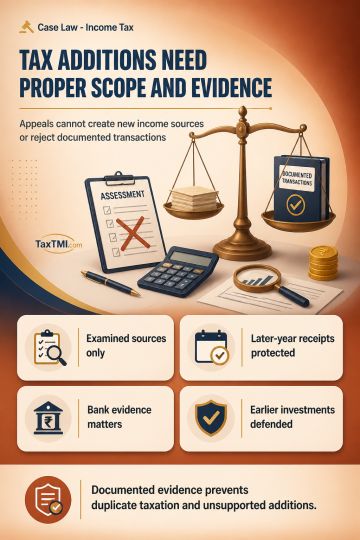
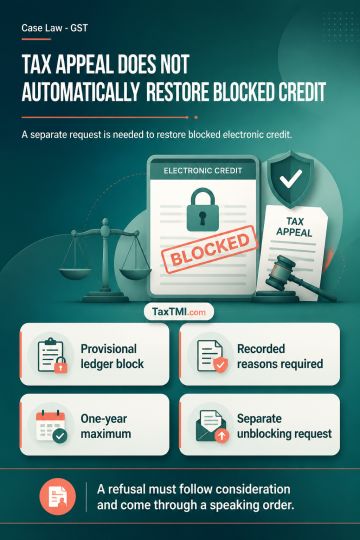
Appellate enhancement limits protect against new income sources, while documented credits and prior-year investments resist unexplained-income additio...
Capital-gains exemption for charitable trusts extends to qualifying fixed deposits, while unrecoverable TDS write-offs may constitute income applicati...
Page of 4868
Press 'Enter' after typing page number.
1 to 20 of 97344 Results
❮
❯
❯❯
0 / 200
Expand Note
Add to Folder
No Folders have been created
+
Are you sure you want to delete "My most important" ?
The AAR held that the GST rate for the project is governed by the one-time option exercised by the original promoter at 12% with input tax credit. The applicant is bound by this project-specific election and cannot switch to a 5% rate without input tax credit. The ruling emphasizes that the tax treatment is project-based, not promoter-specific. Consequently, the applicant must discharge GST at 18% (9% CGST + 9% SGST) with input tax credit, applying a one-third deduction for land value. The option applies uniformly to existing and new buyers, preventing differential tax rates within the same project.
The AAR held that the GST rate for the project is governed by the one-time option exercised by the original promoter at 12% with input tax credit. The applicant is bound by this project-specific election and cannot switch to a 5% rate without input tax credit. The ruling emphasizes that the tax treatment is project-based, not promoter-specific. Consequently, the applicant must discharge GST at 18% (9% CGST + 9% SGST) with input tax credit, applying a one-third deduction for land value. The option applies uniformly to existing and new buyers, preventing differential tax rates within the same project.
Note: It is a system-generated summary and is for quick reference only.
 TaxTMI
  TaxTMI