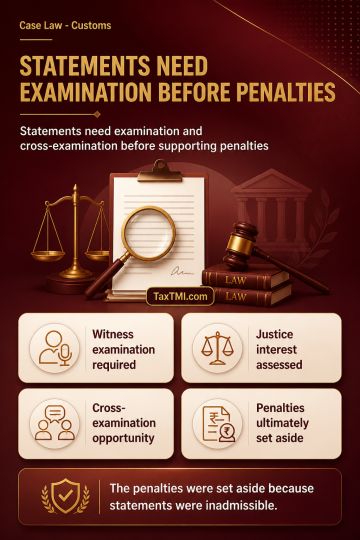
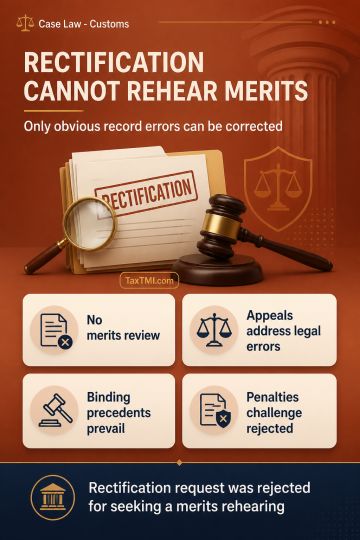
Rectification of mistake remains limited to self-evident record errors, preventing merits review through miscellaneous applications and preserving fin...
Tender creditworthiness conditions may extend to de facto Promoter Directors, with post-participation challenges generally barred absent arbitrariness...
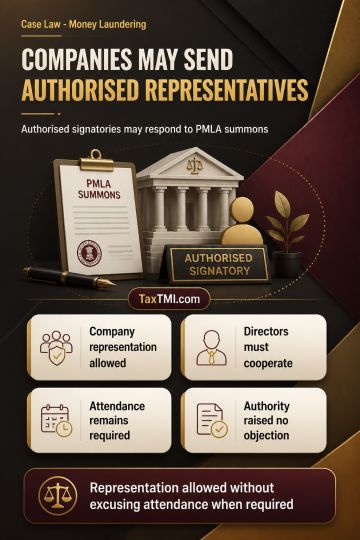
Corporate representation in PMLA summons proceedings permitted through an authorised signatory, subject to directors' continuing cooperation and atten...
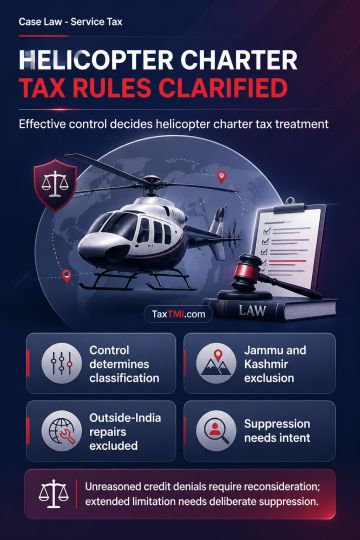
Helicopter charter classification requires effective control analysis, while territorial performance, reasoned credit orders and wilful suppression de...
Specified fund definition expands PAN exemption eligibility for registered alternative investment funds and qualifying International Financial Service...
Tax exemption for specified legal-services authority income applies retrospectively, subject to non-commercial activity, unchanged income sources, and...
The AAAR held that a registered person must reverse Input Tax Credit (ITC) availed on inputs used to manufacture steel nails that were subsequently destroyed in a fire accident. While Section 16 of SGST Act, 2017 generally allows ITC on inputs used in furtherance of business, Section 17(5) specifically prohibits ITC on goods that are "lost, stolen, destroyed or written off." The AAAR emphasized that Section 17(5) contains a non-obstante clause giving it overriding effect over Section 16(1) and Section 18(1). Therefore, despite the appellant's arguments regarding Section 16(1), the AAAR upheld the original Advance Ruling, requiring the appellant to reverse ITC on inputs used in manufacturing the destroyed finished goods.
The AAAR held that a registered person must reverse Input Tax Credit (ITC) availed on inputs used to manufacture steel nails that were subsequently destroyed in a fire accident. While Section 16 of SGST Act, 2017 generally allows ITC on inputs used in furtherance of business, Section 17(5) specifically prohibits ITC on goods that are "lost, stolen, destroyed or written off." The AAAR emphasized that Section 17(5) contains a non-obstante clause giving it overriding effect over Section 16(1) and Section 18(1). Therefore, despite the appellant's arguments regarding Section 16(1), the AAAR upheld the original Advance Ruling, requiring the appellant to reverse ITC on inputs used in manufacturing the destroyed finished goods.
Note: It is a system-generated summary and is for quick reference only.
 TaxTMI
 of 4803















 Join Channel


 TaxTMI