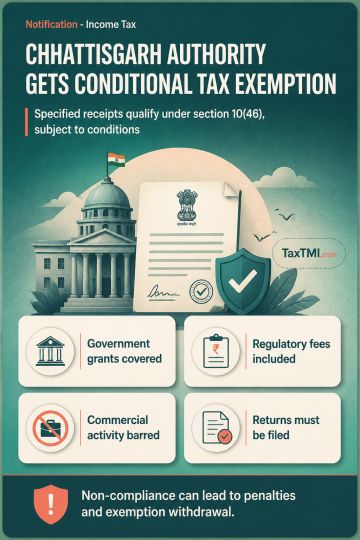
Specified regulatory authority income receives conditional tax exemption, subject to non-commercial activity, unchanged income character, and return f...
Tax exemption for regulatory authority income applies retrospectively, subject to non-commercial activity, unchanged income sources, and return-filing...
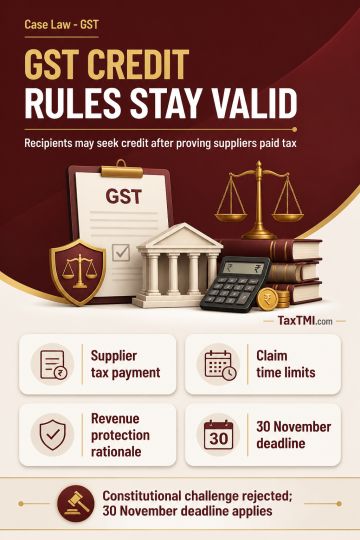
Input tax credit conditions remain constitutionally valid, with eligible recipient claims considered under GST circulars and retrospective filing dead...
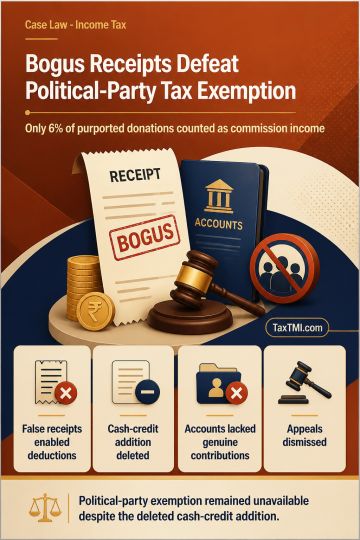
Bogus donation receipts justified commission income assessment and defeated political-party tax exemption for inaccurate accounts and reporting failur...
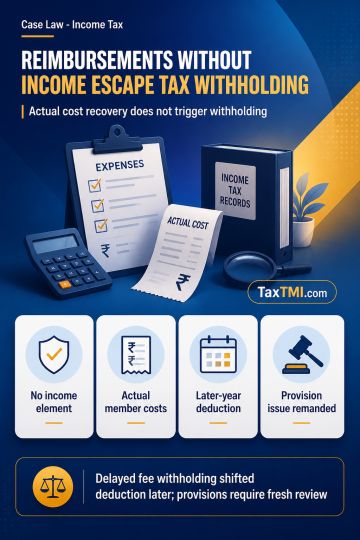
Pure reimbursement without income element escapes tax withholding, while delayed withholding and unsupported provisions face deferred or renewed scrut...
Public benefit requirement defeats charitable registration where residents' association services are reciprocal, member-only facilities governed by mu...
The AAAR held that a registered person must reverse Input Tax Credit (ITC) availed on inputs used to manufacture steel nails that were subsequently destroyed in a fire accident. While Section 16 of SGST Act, 2017 generally allows ITC on inputs used in furtherance of business, Section 17(5) specifically prohibits ITC on goods that are "lost, stolen, destroyed or written off." The AAAR emphasized that Section 17(5) contains a non-obstante clause giving it overriding effect over Section 16(1) and Section 18(1). Therefore, despite the appellant's arguments regarding Section 16(1), the AAAR upheld the original Advance Ruling, requiring the appellant to reverse ITC on inputs used in manufacturing the destroyed finished goods.
The AAAR held that a registered person must reverse Input Tax Credit (ITC) availed on inputs used to manufacture steel nails that were subsequently destroyed in a fire accident. While Section 16 of SGST Act, 2017 generally allows ITC on inputs used in furtherance of business, Section 17(5) specifically prohibits ITC on goods that are "lost, stolen, destroyed or written off." The AAAR emphasized that Section 17(5) contains a non-obstante clause giving it overriding effect over Section 16(1) and Section 18(1). Therefore, despite the appellant's arguments regarding Section 16(1), the AAAR upheld the original Advance Ruling, requiring the appellant to reverse ITC on inputs used in manufacturing the destroyed finished goods.
Note: It is a system-generated summary and is for quick reference only.
 TaxTMI
 of 4801












 Join Channel


 TaxTMI
