Dispute Resolution Panel objections must reach both prescribed forums; otherwise assessment may proceed and statutory appeal remains the proper remedy...
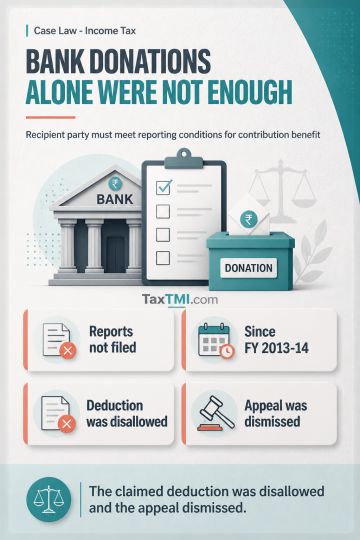
Political contribution deductions require recipient party compliance with contribution-reporting conditions; banking-channel donations alone do not qu...
Aggregation under TNMM prevents selective testing of intra-group services without comparable uncontrolled transactions, while appellate additional cla...
Protective assessment cannot duplicate identical receipts under competing characterisations; remote services did not establish a taxable permanent est...
Current account treatment of overseas tournament services removed most FEMA findings, but excess EEFC remittance and delayed repatriation remained bre...
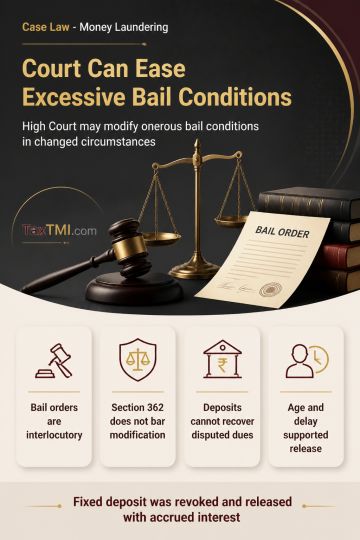
Modification of bail conditions remains available through inherent jurisdiction where onerous deposits undermine justice and cannot recover disputed d...
The AAAR held that a registered person must reverse Input Tax Credit (ITC) availed on inputs used to manufacture steel nails that were subsequently destroyed in a fire accident. While Section 16 of SGST Act, 2017 generally allows ITC on inputs used in furtherance of business, Section 17(5) specifically prohibits ITC on goods that are "lost, stolen, destroyed or written off." The AAAR emphasized that Section 17(5) contains a non-obstante clause giving it overriding effect over Section 16(1) and Section 18(1). Therefore, despite the appellant's arguments regarding Section 16(1), the AAAR upheld the original Advance Ruling, requiring the appellant to reverse ITC on inputs used in manufacturing the destroyed finished goods.
The AAAR held that a registered person must reverse Input Tax Credit (ITC) availed on inputs used to manufacture steel nails that were subsequently destroyed in a fire accident. While Section 16 of SGST Act, 2017 generally allows ITC on inputs used in furtherance of business, Section 17(5) specifically prohibits ITC on goods that are "lost, stolen, destroyed or written off." The AAAR emphasized that Section 17(5) contains a non-obstante clause giving it overriding effect over Section 16(1) and Section 18(1). Therefore, despite the appellant's arguments regarding Section 16(1), the AAAR upheld the original Advance Ruling, requiring the appellant to reverse ITC on inputs used in manufacturing the destroyed finished goods.
Note: It is a system-generated summary and is for quick reference only.
 TaxTMI
 of 4801

















 Join Channel


 TaxTMI
