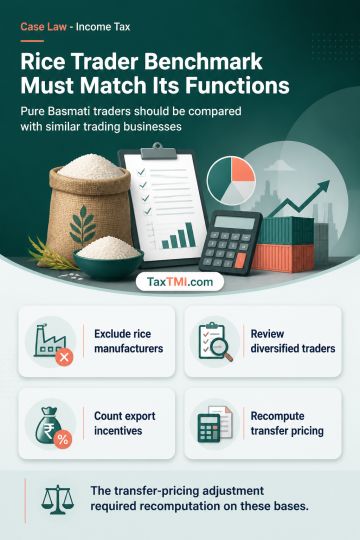
TNMM functional comparability requires excluding rice manufacturers from a pure Basmati rice trader's benchmark and recognising operating export recei...
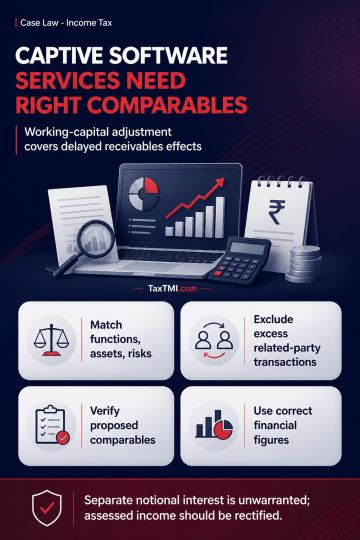
Working-capital adjustment subsumes delayed-receivable effects in TNMM benchmarking of captive software-development services, avoiding separate notion...
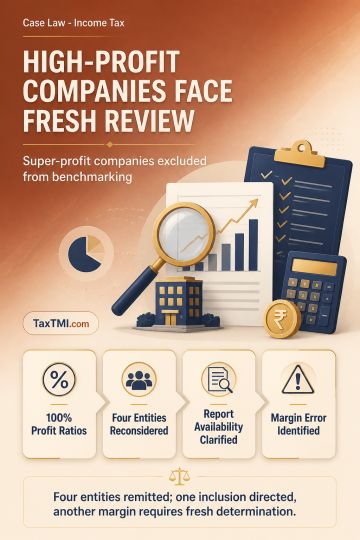
Transfer-pricing comparability requires exclusion of financially illogical super-profit comparables and correction of unsupported annual-report and ma...
Charitable character assessment preserves Section 80G approval despite inclusive spiritual teachings and incidental religious expenditure within the s...
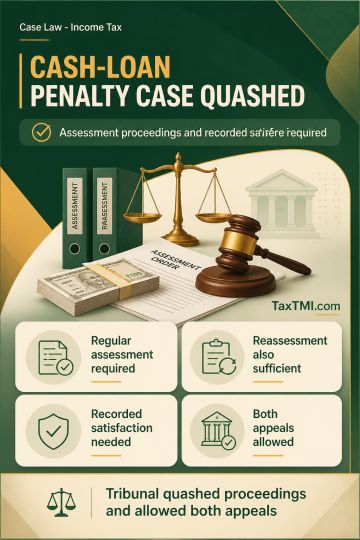
Penalty proceedings for cash-loan acceptance require assessment proceedings and recorded Assessing Officer satisfaction; absent these, the proceedings...
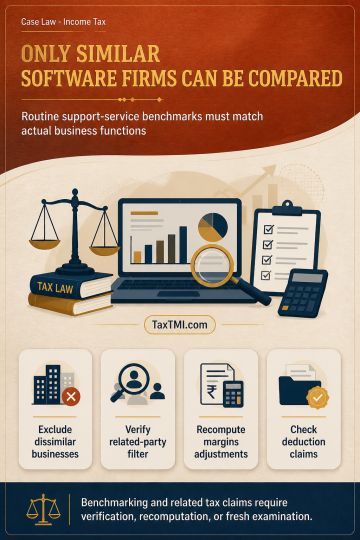
Functional comparability governs software-service benchmarking: dissimilar companies are excluded, while related-party filters, margins and working-ca...
The DGFT, exercising powers under the Foreign Trade (Development & Regulation) Act 1992, has amended export policy conditions for rice under Notification No. 19/2024-2025. For Non-Basmati Rice (ITC(HS) codes 1006 2000, 1006 3010, 1006 3090, 1006 4000), exports to EU Member States, UK, Iceland, Liechtenstein, Norway, and Switzerland require Certificate of Inspection by EIC/EIA. For Basmati Rice (ITC(HS) code 1006 3020), the inspection certificate requirement is waived for exports to non-specified European countries for six months until September 9, 2025. This modification streamlines export procedures by limiting certification requirements to specific European destinations only.
The DGFT, exercising powers under the Foreign Trade (Development & Regulation) Act 1992, has amended export policy conditions for rice under Notification No. 19/2024-2025. For Non-Basmati Rice (ITC(HS) codes 1006 2000, 1006 3010, 1006 3090, 1006 4000), exports to EU Member States, UK, Iceland, Liechtenstein, Norway, and Switzerland require Certificate of Inspection by EIC/EIA. For Basmati Rice (ITC(HS) code 1006 3020), the inspection certificate requirement is waived for exports to non-specified European countries for six months until September 9, 2025. This modification streamlines export procedures by limiting certification requirements to specific European destinations only.
Note: It is a system-generated summary and is for quick reference only.
 TaxTMI
  TaxTMI
 of 4830









 Join Channel


