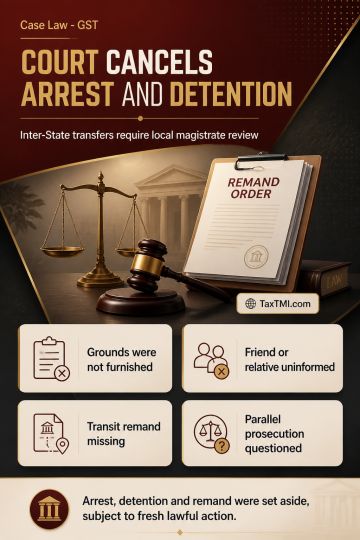
Arrest safeguards and transit remand requirements invalidated detention following inter-State transfer without communicated grounds or magistrate auth...
Arrest safeguards require disclosed grounds, relative intimation and transit remand, while duplicate prosecution under the CGST framework is unsustain...
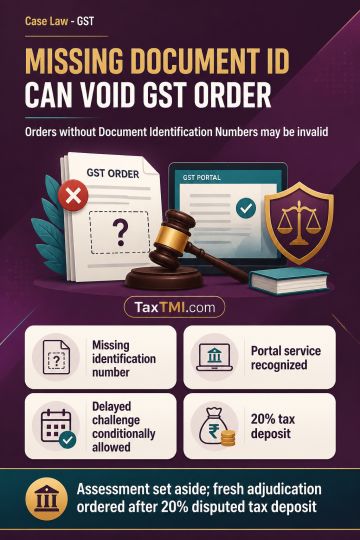
Document Identification Number defects can invalidate GST assessments, with delayed challenges entertained conditionally where patent irregularities e...
Windmill commissioning evidence supported higher depreciation where grid connection and electricity generation proved operational use before the relev...
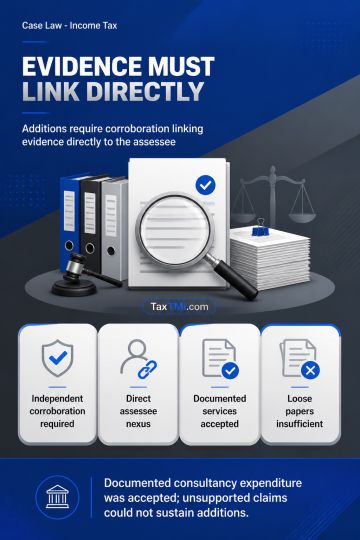
Pharmaceutical promotion and transfer-pricing comparability principles limited disallowances, while uncorroborated search allegations and unsupported ...
Business expenditure substantiation supports scrap credits, statutory payments and expense claims, while depreciation requires proof of actual busines...
Page of 4786
Press 'Enter' after typing page number.
461 to 480 of 95715 Results
❮
❯
❯❯
0 / 200
Expand Note
Add to Folder
No Folders have been created
+
Are you sure you want to delete "My most important" ?
The Income Tax Bill 2025 introduces substantial modifications to residential status provisions compared to the Income-tax Act 1961. Key changes include restructuring into 14 sub-sections, enhanced clarity in determining individual residency through refined 182-day and 60-day rules, and specific provisions for high-income individuals with Rs. 15 lakh threshold. The bill maintains dual criteria for company residency (Indian incorporation or POEM) while expanding POEM definition. NOR status criteria are broadened with additional categories for high-income individuals and deemed residents. The revised framework aligns with international standards, emphasizing substance over form and addressing global mobility concerns. These amendments aim to reduce interpretational disputes while providing clearer guidance for status determination across taxpayer categories.
The Income Tax Bill 2025 introduces substantial modifications to residential status provisions compared to the Income-tax Act 1961. Key changes include restructuring into 14 sub-sections, enhanced clarity in determining individual residency through refined 182-day and 60-day rules, and specific provisions for high-income individuals with Rs. 15 lakh threshold. The bill maintains dual criteria for company residency (Indian incorporation or POEM) while expanding POEM definition. NOR status criteria are broadened with additional categories for high-income individuals and deemed residents. The revised framework aligns with international standards, emphasizing substance over form and addressing global mobility concerns. These amendments aim to reduce interpretational disputes while providing clearer guidance for status determination across taxpayer categories.
Note: It is a system-generated summary and is for quick reference only.
 TaxTMI
 of 4786

















 Join Channel


 TaxTMI