Development agreements require legal possession or effective enjoyment for capital gains transfer; permissive possession and deferred consideration de...
Prolonged sterilisation of development rights supports capital-gains treatment, while business-income disallowances cannot govern capital-gains comput...
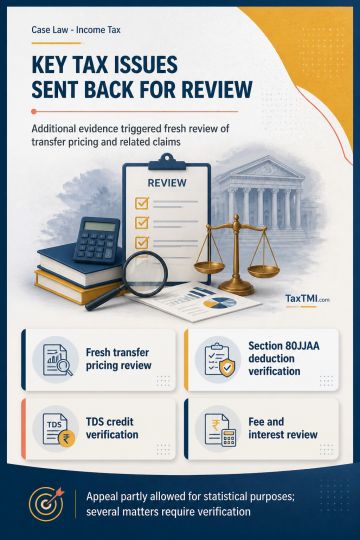
Additional evidence in transfer pricing dispute leads to fresh examination, while tax deductions, TDS credit, fee and refund interest require verifica...
Category II AIF pass-through taxation preserves non-business income character; investment receipts cannot be reclassified without applying recognised ...
Mutual fund maturity rules require proper rollover, redemption, disclosure, and due diligence; investor gains cannot excuse regulatory breaches or pen...
The proposed Income Tax Bill 2025 maintains established principles for income taxation of spouses governed by Portuguese Civil Code in Goa, Dadra and Nagar Haveli, and Daman and Diu. Under Clause 10, spousal income is not assessed as community property despite the "communiao dos bens" concept. Non-salary income is equally apportioned between spouses and included separately in their respective total incomes. Salary income remains exclusively attributed to the earning spouse. The provision retains core principles from Section 5A of Income Tax Act 1961 while introducing structural improvements through simplified language and clearer sub-clauses. This ensures continued tax equity while potentially enhancing implementation efficiency for couples under Portuguese Civil Code jurisdiction.
The proposed Income Tax Bill 2025 maintains established principles for income taxation of spouses governed by Portuguese Civil Code in Goa, Dadra and Nagar Haveli, and Daman and Diu. Under Clause 10, spousal income is not assessed as community property despite the "communiao dos bens" concept. Non-salary income is equally apportioned between spouses and included separately in their respective total incomes. Salary income remains exclusively attributed to the earning spouse. The provision retains core principles from Section 5A of Income Tax Act 1961 while introducing structural improvements through simplified language and clearer sub-clauses. This ensures continued tax equity while potentially enhancing implementation efficiency for couples under Portuguese Civil Code jurisdiction.
Note: It is a system-generated summary and is for quick reference only.
 TaxTMI
 of 4798


















 Join Channel


 TaxTMI
