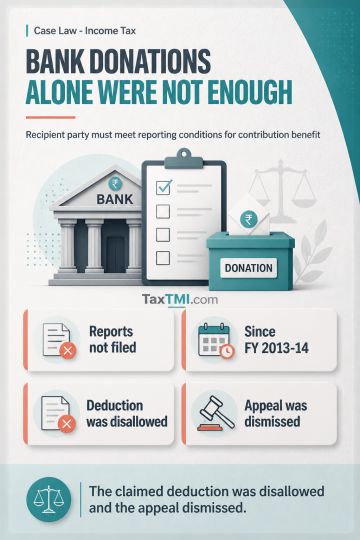
Political contribution deductions require recipient party compliance with contribution-reporting conditions; banking-channel donations alone do not qu...
Aggregation under TNMM prevents selective testing of intra-group services without comparable uncontrolled transactions, while appellate additional cla...
Protective assessment cannot duplicate identical receipts under competing characterisations; remote services did not establish a taxable permanent est...
Current account treatment of overseas tournament services removed most FEMA findings, but excess EEFC remittance and delayed repatriation remained bre...
Modification of bail conditions remains available through inherent jurisdiction where onerous deposits undermine justice and cannot recover disputed d...
Merchant banker regulation consolidates registration, governance, capital, reporting, outsourcing and investor-protection requirements under an update...
The proposed Income Tax Bill 2025 maintains established principles for income taxation of spouses governed by Portuguese Civil Code in Goa, Dadra and Nagar Haveli, and Daman and Diu. Under Clause 10, spousal income is not assessed as community property despite the "communiao dos bens" concept. Non-salary income is equally apportioned between spouses and included separately in their respective total incomes. Salary income remains exclusively attributed to the earning spouse. The provision retains core principles from Section 5A of Income Tax Act 1961 while introducing structural improvements through simplified language and clearer sub-clauses. This ensures continued tax equity while potentially enhancing implementation efficiency for couples under Portuguese Civil Code jurisdiction.
The proposed Income Tax Bill 2025 maintains established principles for income taxation of spouses governed by Portuguese Civil Code in Goa, Dadra and Nagar Haveli, and Daman and Diu. Under Clause 10, spousal income is not assessed as community property despite the "communiao dos bens" concept. Non-salary income is equally apportioned between spouses and included separately in their respective total incomes. Salary income remains exclusively attributed to the earning spouse. The provision retains core principles from Section 5A of Income Tax Act 1961 while introducing structural improvements through simplified language and clearer sub-clauses. This ensures continued tax equity while potentially enhancing implementation efficiency for couples under Portuguese Civil Code jurisdiction.
Note: It is a system-generated summary and is for quick reference only.
 TaxTMI
 of 4782




















 Join Channel


 TaxTMI