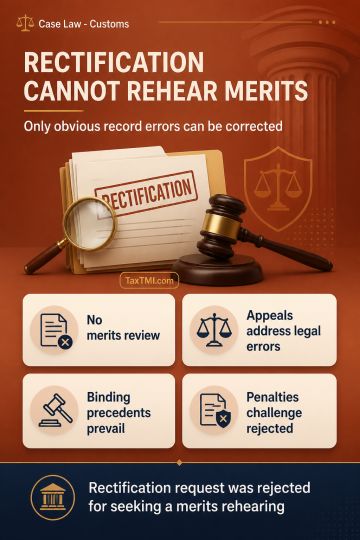
Rectification of mistake remains limited to self-evident record errors, preventing merits review through miscellaneous applications and preserving fin...
Tender creditworthiness conditions may extend to de facto Promoter Directors, with post-participation challenges generally barred absent arbitrariness...
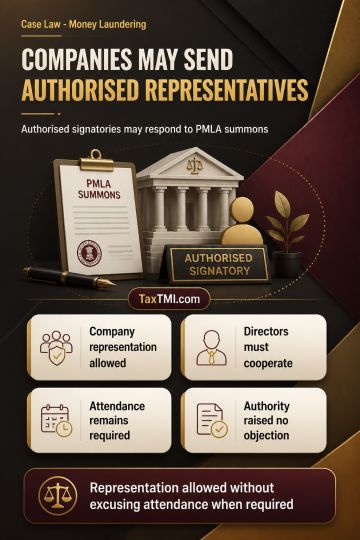
Corporate representation in PMLA summons proceedings permitted through an authorised signatory, subject to directors' continuing cooperation and atten...
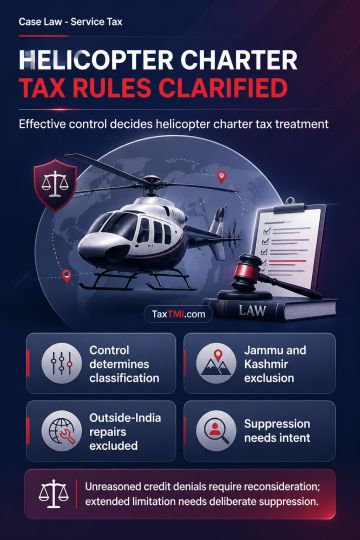
Helicopter charter classification requires effective control analysis, while territorial performance, reasoned credit orders and wilful suppression de...
The High Court held that statements recorded u/s 132(4) of the Income Tax Act, 1961, are admissible evidence u/s 158BD read with Section 3 of the Indian Evidence Act, 1872, and Section 131. In the present case, the husbands of the assessees made statements during search operations that the total investment in constructing the house property was Rs. 15 lakhs, though only Rs. 7 lakhs was accounted for. The assessees reiterated this fact on 03.05.1999. Such statements are presumed true unless the assessees plead that they were obtained forcibly, by coercion, or undue influence. The burden lies on the assessees to establish that the admission is incorrect or wrong. As the assessees failed to discharge this burden, the Tribunal rightly set aside the order passed by the CIT (Appeals), deciding against the assessees.
The High Court held that statements recorded u/s 132(4) of the Income Tax Act, 1961, are admissible evidence u/s 158BD read with Section 3 of the Indian Evidence Act, 1872, and Section 131. In the present case, the husbands of the assessees made statements during search operations that the total investment in constructing the house property was Rs. 15 lakhs, though only Rs. 7 lakhs was accounted for. The assessees reiterated this fact on 03.05.1999. Such statements are presumed true unless the assessees plead that they were obtained forcibly, by coercion, or undue influence. The burden lies on the assessees to establish that the admission is incorrect or wrong. As the assessees failed to discharge this burden, the Tribunal rightly set aside the order passed by the CIT (Appeals), deciding against the assessees.
Note: It is a system-generated summary and is for quick reference only.
 TaxTMI
  TaxTMI
 of 4809









 Join Channel