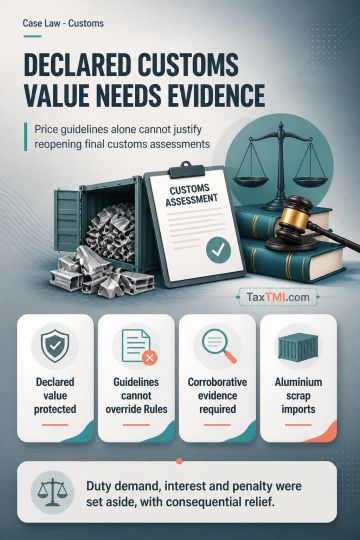
Transaction value cannot be rejected solely on non-statutory valuation guidelines without corroborative evidence supporting reassessment of final cust...
Cross-examination rights and corroborated evidence limit customs penalties for misdeclaration in genuine import transactions involving documented clea...
Tariff classification of vehicle gear components follows the specific gearing entry, displacing motor-vehicle parts classification and related liabili...
Necessary-party requirements limit impleadment of independent entities, while deferred consideration does not create an appealable adverse determinati...
Food supplement classification requires common parlance and authoritative tests, preventing treatment as proprietary Ayurvedic medicines without suppo...
The Securities and Exchange Board of India (SEBI) issued revised guidelines for capacity planning and real-time performance monitoring framework for Market Infrastructure Institutions (MIIs) like stock exchanges, clearing corporations, and depositories. Key requirements include proactive capacity planning methodology, maintaining installed capacity at least 1.5 times projected peak load based on sustained peak trend, comprehensive quarterly stress testing, horizontal and vertical scalability testing, automated performance monitoring with predefined thresholds and alert systems, maintaining asset registers, enhancing capacity if utilization exceeds 75%, assessing impact of changes, including requirements in vendor SLAs, and having a defined policy approved by Standing Committee on Technology and Board. MIIs must submit revised guidelines to SEBI within 3 months after board approval.
The Securities and Exchange Board of India (SEBI) issued revised guidelines for capacity planning and real-time performance monitoring framework for Market Infrastructure Institutions (MIIs) like stock exchanges, clearing corporations, and depositories. Key requirements include proactive capacity planning methodology, maintaining installed capacity at least 1.5 times projected peak load based on sustained peak trend, comprehensive quarterly stress testing, horizontal and vertical scalability testing, automated performance monitoring with predefined thresholds and alert systems, maintaining asset registers, enhancing capacity if utilization exceeds 75%, assessing impact of changes, including requirements in vendor SLAs, and having a defined policy approved by Standing Committee on Technology and Board. MIIs must submit revised guidelines to SEBI within 3 months after board approval.
Note: It is a system-generated summary and is for quick reference only.
 TaxTMI
 of 4805


















 Join Channel


 TaxTMI
