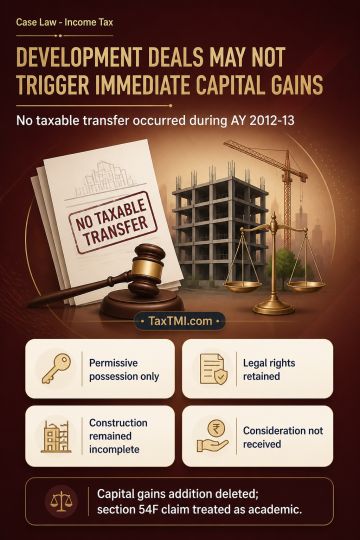
Development agreements require legal possession or effective enjoyment for capital gains transfer; permissive possession and deferred consideration de...
Prolonged sterilisation of development rights supports capital-gains treatment, while business-income disallowances cannot govern capital-gains comput...
Additional evidence in transfer pricing dispute leads to fresh examination, while tax deductions, TDS credit, fee and refund interest require verifica...
Category II AIF pass-through taxation preserves non-business income character; investment receipts cannot be reclassified without applying recognised ...
The High Court dismissed the petition challenging the requirement of pre-deposit of Rs. 10 crore for filing an appeal before the CESTAT u/s 35F of the Central Excise Act, 1944. The court held that it lacked discretion to grant a waiver or reduction in the pre-deposit amount, as it would be contrary to the legislative intent. The petitioner was directed to avail the alternative statutory remedy of filing an appeal before the CESTAT. The court observed that while considering a waiver, it must examine if the petitioner has a prima facie case likely to succeed, indicating no gross injustice, excessive demand contrary to facts, or perverse orders, coupled with blameless conduct. However, after examining the facts, the court found no merit to grant a waiver and dismissed the petition.
The High Court dismissed the petition challenging the requirement of pre-deposit of Rs. 10 crore for filing an appeal before the CESTAT u/s 35F of the Central Excise Act, 1944. The court held that it lacked discretion to grant a waiver or reduction in the pre-deposit amount, as it would be contrary to the legislative intent. The petitioner was directed to avail the alternative statutory remedy of filing an appeal before the CESTAT. The court observed that while considering a waiver, it must examine if the petitioner has a prima facie case likely to succeed, indicating no gross injustice, excessive demand contrary to facts, or perverse orders, coupled with blameless conduct. However, after examining the facts, the court found no merit to grant a waiver and dismissed the petition.
Note: It is a system-generated summary and is for quick reference only.
 TaxTMI
  TaxTMI
 of 4807















 Join Channel


