Statutory transfer formalities invalidated alleged share and property transfers, while retrospective record manipulation constituted oppression and mi...
Provisional attachment of laundered funds and equivalent-value property sustained, with statutory protection limited to pension, gratuity and providen...
Insolvency moratorium does not shield company officers from cheque dishonour prosecution for liability arising before corporate insolvency proceedings...
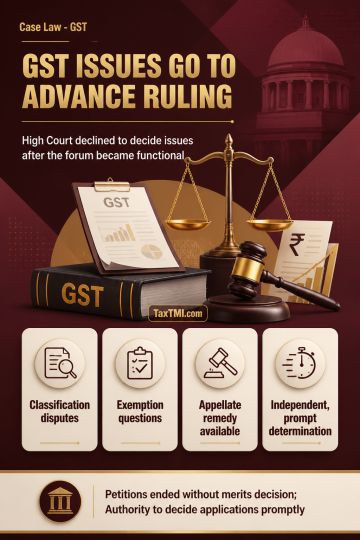
Advance-ruling mechanism governs pending GST classification, exemption and taxability disputes, limiting writ review once the specialised forum functi...
Page of 4788
Press 'Enter' after typing page number.
581 to 600 of 95752 Results
❮
❯
❯❯
0 / 200
Expand Note
Add to Folder
No Folders have been created
+
Are you sure you want to delete "My most important" ?
Benefit under Direct Tax Vivad Se Vishwas Act, 2020 was considered for a case where no appeal, writ petition, or special leave petition was pending before the appellate forum as on the cut-off date, but a review petition against dismissal of the special leave petition was pending. The court held that even though the scope of a review petition is limited, it partakes the character of pending proceedings. The CBDT circulars clarified that pendency of arbitration proceedings and miscellaneous applications would meet the requirement u/s 2(1)(j) of the Act, even if no appeal was pending. The court ruled that the review petition would also be covered under the "Vivad Se Vishwas Scheme" as the DTVSV Act provides for deviation from strict application of tax laws to achieve its purpose. The impugned order rejecting the declaration was set aside, and the department was directed to accept the revised declaration form and process it under the DTVSV Act, 2020.
Benefit under Direct Tax Vivad Se Vishwas Act, 2020 was considered for a case where no appeal, writ petition, or special leave petition was pending before the appellate forum as on the cut-off date, but a review petition against dismissal of the special leave petition was pending. The court held that even though the scope of a review petition is limited, it partakes the character of pending proceedings. The CBDT circulars clarified that pendency of arbitration proceedings and miscellaneous applications would meet the requirement u/s 2(1)(j) of the Act, even if no appeal was pending. The court ruled that the review petition would also be covered under the "Vivad Se Vishwas Scheme" as the DTVSV Act provides for deviation from strict application of tax laws to achieve its purpose. The impugned order rejecting the declaration was set aside, and the department was directed to accept the revised declaration form and process it under the DTVSV Act, 2020.
Note: It is a system-generated summary and is for quick reference only.
 TaxTMI
 of 4788
















 Join Channel


 TaxTMI